Key points
- Licenses from Comoros or Anjouan are issued by local authorities primarily for domestic commerce, not typically for international retail forex/CFD trading.
- The regulatory oversight and investor protection mechanisms in these jurisdictions are significantly less stringent compared to established financial centers.
- Verifying these licenses requires direct contact with the specific island authority, which may offer limited transparency or enforcement capabilities for non-residents.
- Brokers operating solely under these licenses often lack critical protections like segregated client funds, negative balance protection, or access to independent dispute resolution.
- A broker's choice of such a license often indicates an intent to operate with minimal regulatory burden, placing a higher risk on the trader.
- Always prioritize brokers licensed by well-known regulatory bodies like the FCA, ASIC, or CySEC for meaningful investor safeguards.
The Rise of Unfamiliar Regulatory Claims
In recent years, the online trading sector has seen a growing number of brokerage platforms presenting licensing from jurisdictions such as the Union of the Comoros or its autonomous island of Anjouan. These entities often operate under names like the 'Mwali International Services Authority' (MISA) for Comoros or the 'Anjouan Financial Services Authority' (AFSA). A prospective trader, accustomed to seeing names like the UK's Financial Conduct Authority (FCA) or Australia's ASIC, may reasonably wonder about the legitimacy and implications of these less familiar claims. Unlike regulators that have developed extensive frameworks for cross-border retail financial services, the authorities in Comoros and Anjouan are primarily structured to oversee local business activities.
Anjouan Financial Services Authority: Scope and Limitations
The Anjouan Financial Services Authority (AFSA) is an entity that issues licenses for various financial activities. For a broker to claim AFSA regulation, they would typically register a legal entity on the island of Anjouan and obtain an appropriate license from this authority. While AFSA issues licenses, their scope and the level of supervision they provide for international retail forex or CFD trading differ substantially from those of established financial regulators. The core purpose of these authorities is often to attract foreign investment and establish a local financial services industry, rather than to provide globally recognized investor protections. This is the part most guides skip: even if a license is 'validly issued' by a local body, its practical enforcement for cross-border financial services often lacks teeth, leaving international clients in a vulnerable position.
Comparison of AFSA Oversight with Established Financial Regulators
| Regulatory Aspect | Anjouan Financial Services Authority (AFSA) | Established Regulator (e.g., FCA, ASIC) |
|---|---|---|
| Primary Mandate | Local economic development, business registration | Investor protection, market integrity, systemic stability |
| Investor Compensation Scheme | Generally absent or undefined for international clients | Mandatory schemes (e.g., FSCS in UK, up to £85,000) |
| Capital Requirements for Brokers | Lower or less stringent | Substantial, regularly audited, and publicly disclosed |
| Segregation of Client Funds | Not consistently mandated or enforced | Strictly mandated, held in separate bank accounts from company funds |
| Dispute Resolution Mechanisms | Limited or relies on local legal system | Independent ombudsman services (e.g., FOS in UK, AFCA in Australia) |
| Leverage Limits for Retail | Typically very high or unrestricted (e.g., 1:1000+) | Capped at 1:30 for retail clients (under ESMA intervention-aligned rules) |
| Negative Balance Protection | Not typically guaranteed | Mandatory for retail clients in many jurisdictions |
The Mwali International Services Authority (MISA)
Similar to Anjouan, the island of Mwali (Moheli) within the Comoros Union also has an authority purporting to license international financial services: the Mwali International Services Authority (MISA). Brokers claiming MISA oversight operate under a very similar model to those citing AFSA. The underlying principle is often the attraction of foreign entities through a framework that prioritizes ease of setup and reduced operational costs over rigorous compliance and investor safeguards. While a MISA license might technically be 'issued', its capacity to provide meaningful oversight, enforce sophisticated regulatory standards, or offer recourse to international traders experiencing issues remains highly questionable. Traders should approach any broker exclusively licensed by MISA with significant caution, understanding that their protections are likely minimal.
Practical Steps for License Verification
Verifying a license from an obscure jurisdiction is often a more complex process than checking against the well-maintained registers of established authorities. For instance, to confirm an FCA license, a trader can simply visit the FCA's Financial Services Register and search by firm name or registration number. Similarly, ASIC's Professional Registers allow for straightforward checks. For AFSA or MISA, the situation is different. Typically, verification would involve visiting the official website of the specific authority (e.g., afsa.km for Anjouan or a similar site for Mwali, if available and consistently maintained) and searching their online registry. However, these registries may be less complete, less frequently updated, or even offline. Some authorities may require direct email correspondence to confirm a license status, which can be slow and may not provide sufficient detail regarding the broker's compliance record or any disciplinary actions. In practice, the desk will ask twice for documentation, but verifying an obscure regulatory claim requires the trader to be twice as diligent.
A Comparative Guide to Verifying Broker Licenses
| Step | Action Required | Expected Outcome (Established Regulator) | Expected Outcome (Comoros/Anjouan Authority) |
|---|---|---|---|
| 1. Obtain Details | Note broker's registered entity name and license number from their website. | Clearly stated, often with direct link to regulator's page. | May be ambiguous, presented as text-only, or hard to find. |
| 2. Access Regulator's Register | Visit the official website of the claimed regulator. | Easy to find, searchable online register. | Website may be basic, register may be offline, broken, or require manual search. |
| 3. Search for Entity | Enter broker's name or license number. | Instant results, firm details, regulated activities, status, contact info. | Search may fail, entity not listed, or only minimal details provided. |
| 4. Contact Regulator (if needed) | Email or call the authority for confirmation. | Prompt, informative response detailing license scope and status. | Slow response, generic reply, or no response at all; limited useful information. |
| 5. Assess Scope | Confirm the license covers the specific services offered (e.g., forex, CFDs to retail clients). | Explicitly detailed on register and in correspondence. | Often vague, may only cover 'general financial services' or 'company registration'. |
A broker's choice of an obscure license often indicates an intent to operate with minimal regulatory burden, placing a higher risk on the trader.
Alan Reeve
Why Brokers Seek Out These Jurisdictions
Brokers choose to establish entities in jurisdictions like Comoros and Anjouan for several reasons, primarily centered around reduced regulatory burdens and operating costs. Regulators in major financial hubs impose strict capital requirements, demand regular audits, and require extensive reporting on client funds and trading activities. They also mandate investor protection measures such as segregated accounts, negative balance protection, and participation in compensation schemes. These requirements are expensive and complex to maintain. By contrast, obtaining a license from AFSA or MISA typically involves a simpler, faster, and significantly less costly application process. The ongoing compliance requirements are often minimal, allowing brokers to offer higher leverage (e.g., 1:500 or 1:1000, compared to 1:30 in the EU or UK) and operate with fewer restrictions on marketing or product offerings. This attracts a segment of traders seeking higher leverage, but it comes at the steep cost of relinquished safety.
The Absence of Strong Investor Protection
The most significant disadvantage for traders dealing with brokers licensed solely by authorities in Comoros or Anjouan is the almost complete absence of strong investor protection. In regulated environments, client funds are legally required to be held in segregated bank accounts, separate from the broker's operational capital. This means that if the broker faces financial difficulties or goes bankrupt, client funds are protected and cannot be used to pay off the broker's creditors. In addition, many reputable jurisdictions offer investor compensation schemes, such as the Financial Services Compensation Scheme (FSCS) in the UK, which protects eligible clients up to a specified amount (currently £85,000) if a regulated firm fails. Independent dispute resolution services, like the UK's Financial Ombudsman Service, provide a neutral avenue for clients to resolve complaints without resorting to costly and time-consuming litigation. None of these critical safeguards are reliably present or enforceable when dealing with a broker licensed by authorities such as AFSA or MISA, leaving traders with minimal recourse in the event of a dispute or firm collapse.
Recognizing the Risks: Beyond the License
Beyond the specific licensing claim, traders should be vigilant for other indicators of a potentially problematic brokerage. Unsolicited contact through social media or messaging apps, particularly with promises of guaranteed returns or high-pressure sales tactics, is a significant red flag. Brokers operating with obscure licenses often lack transparency regarding their ownership, management, and operational structure. Difficulty in finding credible, independent reviews, or an abundance of negative feedback citing withdrawal problems, execution manipulation, or unresponsive customer service should also trigger concern. A regulated broker, such as Pepperstone, OANDA, or XM, will typically have clear information about their various regulated entities, their headquarters, and their compliance with local laws across multiple jurisdictions. The presence of a Comoros or Anjouan license does not automatically equate to fraud, but it strongly signals a higher risk environment for the retail trader.
The Operational Disparity Between Established and Obscure Regulatory Bodies
The mere presence of a license does not equate to uniform protection across all jurisdictions. A fundamental difference exists in the operational efficacy and underlying requirements imposed by well-known regulatory bodies compared to those in less recognized territories like Comoros or Anjouan. Reputable regulators such as the UK’s Financial Conduct Authority (FCA), Australia’s ASIC, or Cyprus’s CySEC, demand significant capital reserves from firms. For instance, an investment firm holding client money in the UK typically requires initial capital of €730,000. This capital serves as a buffer against insolvency and ensures firms can meet their obligations, even during periods of market volatility. In contrast, the capital requirements for a general financial services license from authorities like the AFSA or MISA can be considerably lower, sometimes reportedly as little as $10,000 or $20,000, which offers minimal financial backing in a crisis. This discrepancy alone highlights a vastly different level of financial stability and commitment expected from licensed entities.
Beyond capital, established authorities often mandate strict segregation of client funds from company operational funds, typically held in separate trust accounts with top-tier banks. This measure ensures that client money is protected if the brokerage itself faces financial difficulties. Credible jurisdictions often operate investor compensation schemes. For example, the UK's Financial Services Compensation Scheme (FSCS) can protect eligible deposits and investments up to £85,000 per person per firm, while Cyprus’s Investor Compensation Fund (ICF) offers protection up to €20,000. These schemes provide a crucial safety net for traders in the event of broker insolvency. Such compensation mechanisms are generally absent or severely limited in jurisdictions like Comoros, leaving traders with little recourse if a licensed entity fails. pipvet.com advises that traders verify these specific protections are in place for the entity they are dealing with. The operational differences manifest in daily oversight, compliance audits, and the general standard of conduct expected, fostering an environment where brokers regulated by such obscure authorities may operate with significantly less scrutiny and accountability than their counterparts in major financial centers. This disparity means the ‘license’ from an obscure authority offers little more than a superficial assurance.
The Multi-Jurisdictional Brokerage Structure
Many widely recognized brokerage brands, such as Pepperstone, OANDA, or XM, operate through multiple legal entities, each regulated in different jurisdictions. While their websites might prominently feature licenses from respected authorities like the FCA, ASIC, or CySEC, it is crucial for traders to understand that they may not necessarily be contracting with the entity holding these stringent licenses. Brokers often establish entities in offshore or less-regulated jurisdictions to cater to clients from regions where stricter regulations might limit product offerings, such as leverage ratios, or to bypass certain compliance requirements. For example, a broker might have an entity regulated by the FCA for UK clients, another by ASIC for Australian clients, and a separate entity in, for instance, Seychelles (like the FSA Seychelles, which regulates some entities of brokers such as Exness or IC Markets) or Belize for international clients from regions with less restrictive financial oversight.
This multi-entity structure means that the level of protection a trader receives depends entirely on the specific legal entity they sign up with. It is not uncommon for a broker's website to present its most reputable licenses upfront, while details of the entity that will actually hold a client's account are located deep within the 'Terms and Conditions,' 'Client Agreement,' or during the account opening process. A diligent trader must locate and scrutinize the legal name of the entity they are registering with, confirm its registered address, and then independently verify its licensing status with the stated regulatory body for that specific entity. Simply seeing a logo of a well-known regulator on a broker's homepage is insufficient. For instance, if a client from a non-EU country is directed to an entity regulated by an authority in Comoros, their protections will derive solely from that Comoros license, regardless of the brand's other, more credible licenses elsewhere. The appearance of choice can be misleading; the actual choice rests in carefully identifying the contracting party and its specific regulatory oversight. Traders are strongly urged to proactively ask the broker which specific legal entity they will be onboarding with and to verify that entity's license directly with the relevant authority's public register before depositing any funds.
The Practicalities of Seeking Recourse with Obscure Authorities
When a trading dispute arises, the ability to seek effective recourse is a critical aspect of investor protection. For traders engaging with brokers regulated by established authorities like the US CFTC/NFA, the UK’s FCA, or Australia’s ASIC, a clear, multi-stage process for dispute resolution generally exists. Typically, the first step involves lodging a formal complaint directly with the broker. If the issue remains unresolved after a stipulated period (e.g., eight weeks for FCA-regulated firms), the trader can then escalate the matter to an independent external dispute resolution (EDR) body, such as the Financial Ombudsman Service (FOS) in the UK or the Australian Financial Complaints Authority (AFCA). These EDR bodies are designed to mediate and adjudicate disputes impartially, often at no cost to the complainant, and their decisions are binding on the regulated firm up to a certain financial limit. As noted, compensation schemes like the FSCS or ICF may also offer financial protection against broker insolvency.
In stark contrast, seeking meaningful recourse from a broker licensed solely by an obscure authority in Comoros or Anjouan presents significant practical hurdles. These jurisdictions typically lack independent ombudsman services or effective investor compensation funds. A trader's only avenue for official complaint may be directly to the licensing authority itself, such as the AFSA or MISA. However, the operational capacity, transparency, and enforcement power of these authorities to effectively resolve international disputes against their licensees are often questionable. Communication can be challenging due to language barriers and geographical distance. The process might be opaque, protracted, or simply unresponsive, leaving the trader with little leverage. Legal action in the broker's registered jurisdiction is an option, but the costs associated with international litigation, including legal fees, travel, and translation services, can quickly run into tens of thousands of dollars, far outweighing the potential recovery for most retail traders. Even if a judgment is obtained, enforcing it against an entity in a distant, unfamiliar legal system can be exceedingly difficult. This practical reality means that for brokers licensed only by such obscure entities, the regulatory framework offers negligible, if any, effective protection to the individual trader in the event of a dispute.
Securing Your Trading Capital
The choice of brokerage significantly impacts the safety of your trading capital. While the lure of high leverage or simplified account opening from brokers with Comoros or Anjouan licenses might be strong, the trade-off in terms of investor protection is substantial. A sober assessment reveals that the benefits of strong regulation—segregated funds, compensation schemes, independent dispute resolution, and clear regulatory oversight—far outweigh any perceived advantages of less regulated environments. Prioritizing brokers with licenses from well-established, reputable authorities remains the most prudent approach for retail traders seeking to safeguard their investments and ensure fair treatment. Always verify a broker's licensing directly with the stated regulator using official channels, and understand the practical implications of that license for your specific financial safety. Your vigilance is the first line of defense against potential financial missteps.
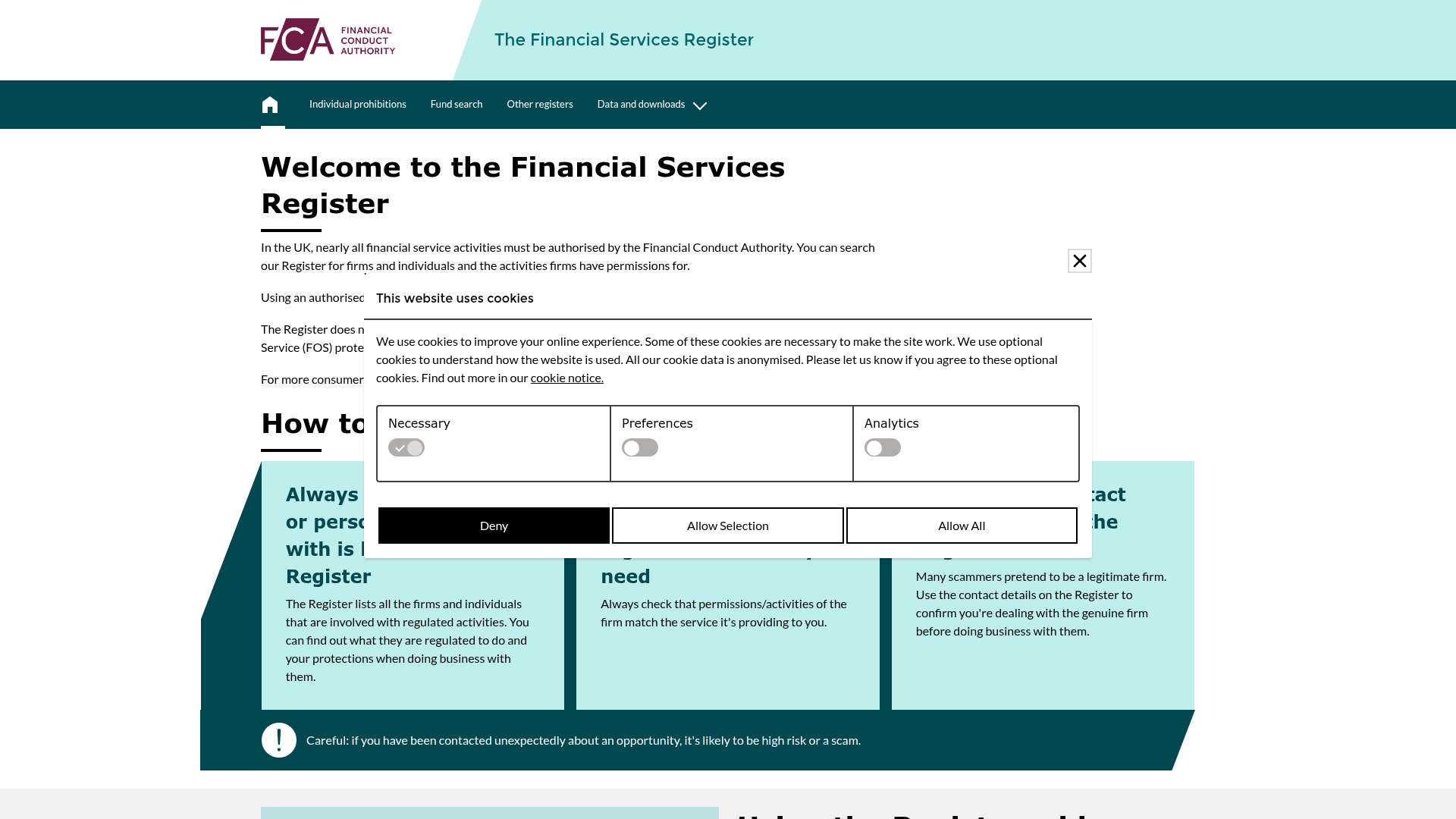
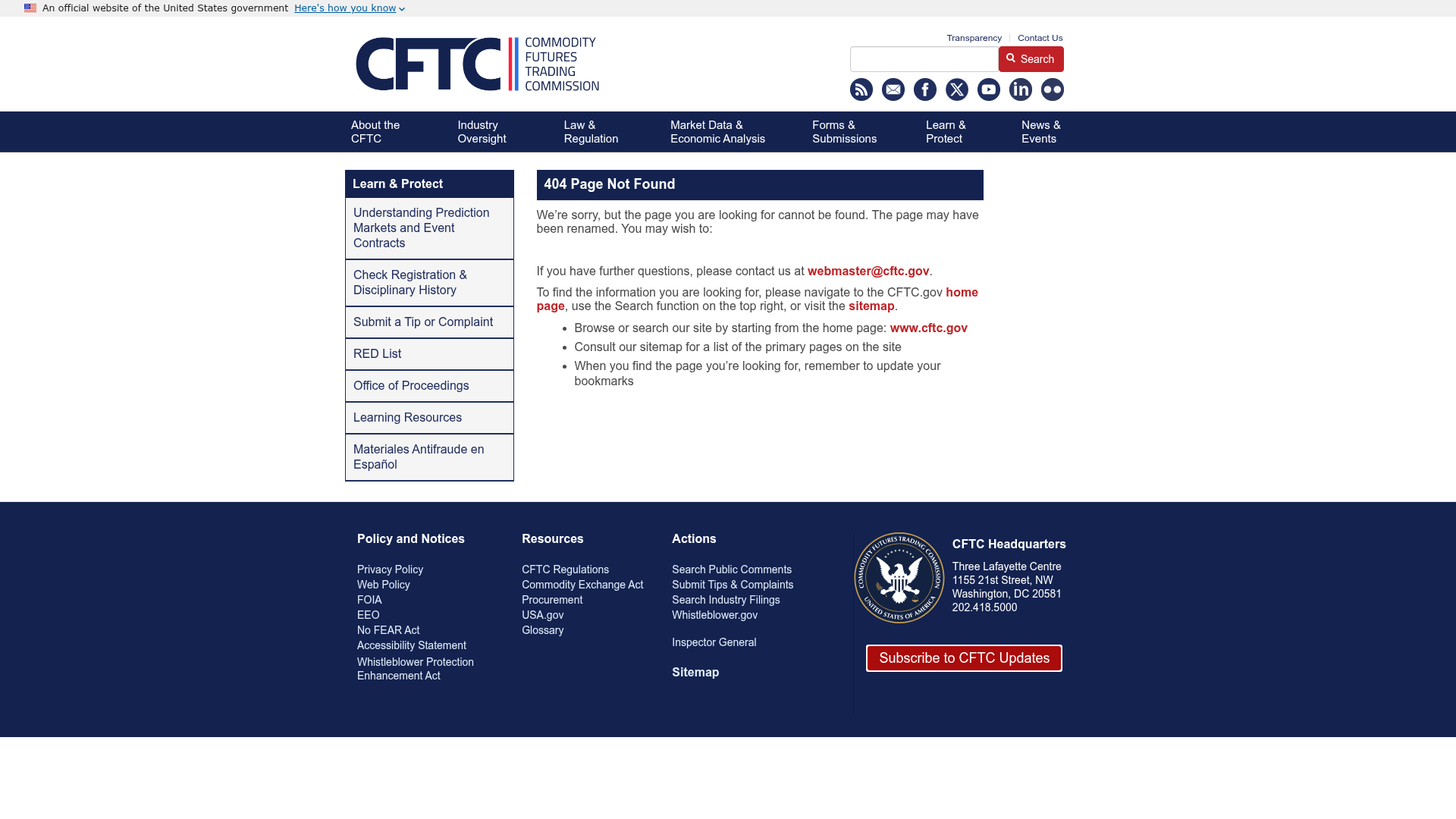
The page we check
This is the authority's own page, captured as we found it. Open it and run the same search yourself — nothing on this register replaces the source.
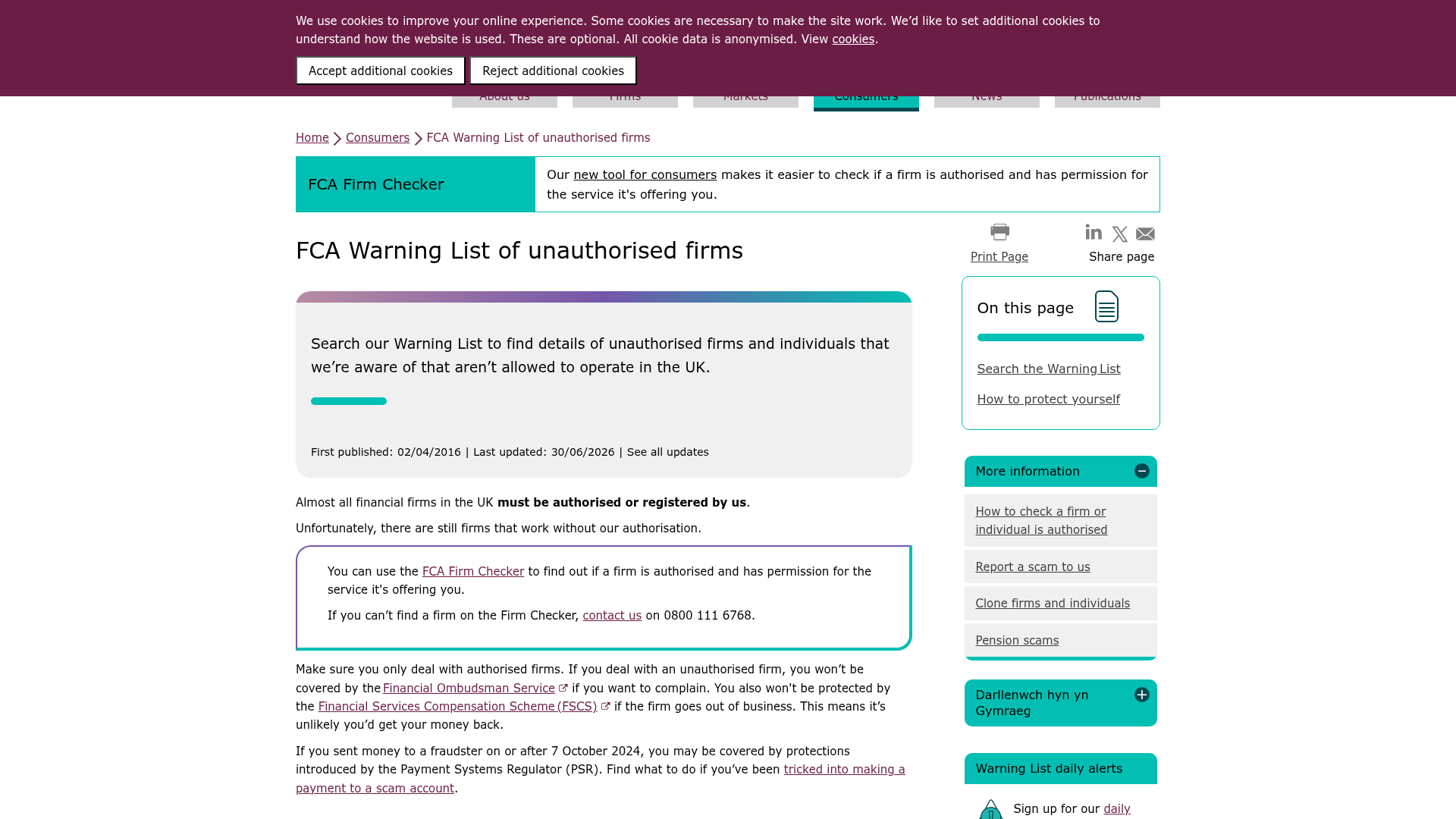
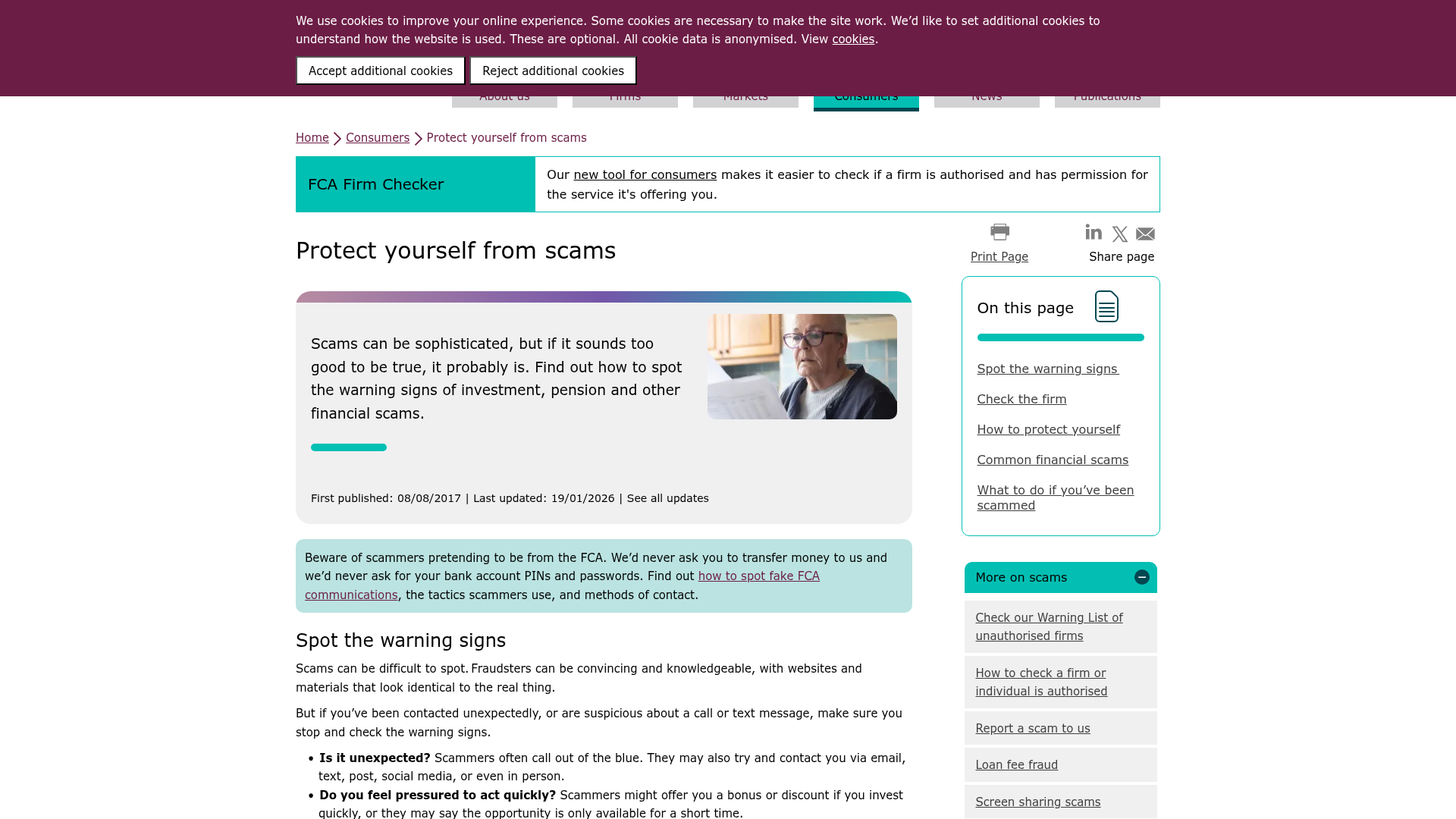
Other registers used in checks of this kind. Each opens the authority's own page.
Primary sources
Every claim above can be checked against the authority's own page. These open on the regulator's site, not ours.
- Financial Conduct Authority — Financial Services Registerregister.fca.org.ukhttps://register.fca.org.uk/
- FCA — Warning list of unauthorised firmsfca.org.ukhttps://www.fca.org.uk/consumers/warning-list-unauthorised-firms
- CFTC — Registration Deficient (RED) Listcftc.govhttps://www.cftc.gov/check
- ESMA — Product intervention on CFDsesma.europa.euhttps://www.esma.europa.eu/press-news/esma-news/esma-agrees-prohibit-binary-options-and-restrict-cfds-protect-retail
- Financial Services Compensation Scheme (FSCS)fscs.org.ukhttps://www.fscs.org.uk/what-we-cover/investments/
Frequently asked
What is an Anjouan Financial Services Authority (AFSA) license?
The AFSA is an authority on the autonomous Comorian island of Anjouan that issues licenses for various business activities, including financial services. While it grants official status within Anjouan, its regulatory framework and investor protection measures for international retail trading are generally not comparable to those of major global financial regulators.
Is a broker licensed by Mwali International Services Authority (MISA) safe?
A MISA license from the Comorian island of Mwali typically means the broker has met local registration requirements. However, it does not guarantee the same level of safety, fund segregation, or dispute resolution mechanisms as licenses from well-known regulators like the FCA or ASIC. Traders should exercise extreme caution.
How can I verify a Comoros or Anjouan license?
You would need to visit the official website of the specific authority (e.g., AFSA or MISA) and attempt to search their online register or contact them directly. Be aware that these registries may be less complete or reliable than those of established regulators, and direct verification can be challenging.
What protections are missing with these licenses?
Critical protections often absent include mandatory segregation of client funds from company capital, participation in investor compensation schemes (like the FSCS), negative balance protection, and access to independent, external dispute resolution services. This leaves traders with little recourse if problems arise.
Why do some brokers use these types of licenses?
Brokers often choose these jurisdictions for lower operational costs, less stringent capital requirements, simpler application processes, and fewer restrictions on leverage or product offerings. This allows them to operate with significantly reduced regulatory oversight compared to brokers in major financial hubs.
Which regulators provide stronger investor protection?
Regulators such as the UK's Financial Conduct Authority (FCA), Australia's ASIC, Cyprus's CySEC, the US's CFTC/NFA, and Singapore's MAS are known for strong regulatory frameworks, strict enforcement, and extensive investor protection measures. Always prioritize brokers regulated by such authorities.