
Key points
- Always verify a firm's Firm Reference Number (FRN) directly on the FCA Register, never from links provided by the firm's website.
- Firms claiming FCA regulation must be explicitly listed with appropriate permissions for the specific financial services they offer, not just general authorization.
- Be alert to 'clone firms' which illegally mimic legitimate regulated entities; cross-reference all contact details and FRNs meticulously.
- Understand that being on the register does not guarantee a firm's solvency or investment performance, only its authorization and adherence to specific rules.
- The Financial Services Compensation Scheme (FSCS) offers protection up to £85,000 for eligible claims against authorized investment firms, but it is not universal.
- Offshore regulation for a UK-targeting firm should trigger immediate caution, as it provides minimal or no equivalent consumer protection under UK law.
The First Principle: Direct Verification
Each year, UK financial fraud costs consumers hundreds of millions of pounds, often stemming from interactions with unauthorized investment firms. Imagine you are presented with an attractive offer for high-yield forex trading. The website is polished, the testimonials compelling, and a prominent badge declares 'Regulated by the FCA'. Your immediate, instinctive action should not be to click that badge, nor to search for the firm's name on a general search engine, which can be manipulated. Instead, the only safe starting point is to directly navigate to the Financial Conduct Authority's official website at register.fca.org.uk.
This single, non-negotiable step isolates you from a common initial deception: fraudulent firms creating imposter websites or manipulating search results to funnel victims to their own fake verification pages. The FCA Register is the definitive public record of financial firms, individuals, and markets that the FCA regulates. It details what types of financial services firms are permitted to offer and under what conditions.
Your vigilance here is the foundational layer of protection. Without it, any subsequent checks or reassurances are built on sand. Many firms, such as Pepperstone, OANDA, FxPro, and eToro, do hold FCA regulation for their UK operations, and their details will be accurately reflected on this official register. The objective is to independently confirm their presence and permissions, without relying on any information supplied by the firm itself until initial verification is complete.
Locating a Firm: The Firm Reference Number (FRN)
Once on the official FCA Register, your most efficient and accurate search tool is the Firm Reference Number (FRN). This unique seven-digit identifier is assigned by the FCA to every authorized firm. Reputable firms will often display their FRN on their website's footer or 'About Us' section, clearly stating their regulatory status. For example, a legitimate broker like Plus500, which is FCA regulated, will typically publish its FRN alongside its registration details.
Searching by FRN is far more precise than searching by firm name. A firm name might be generic, or a deceptive firm might use a name very similar to a legitimate one. An FRN, however, is unique. If a firm does not display its FRN, this is an immediate indicator for heightened caution; while not definitive proof of wrongdoing, it complicates your direct verification efforts.
Should you only have the firm's name, ensure your search on the FCA Register uses the exact legal entity name. Pay close attention to variations in spelling, suffixes like 'Ltd' or 'LLP', and any additional trading names. A small discrepancy could hide an unauthorized entity operating under a subtly altered name to mislead consumers. The goal is to match precisely what the FCA has on record with what the firm presents to you.
Unpacking Permissions: What Can This Firm Actually Do?
Finding a firm on the FCA Register is only the first part of the verification process. The next critical step, often overlooked, is to examine its 'Permissions'. This section details the specific financial activities the firm is authorized to conduct. A firm might be regulated by the FCA, but for an entirely different service than what it's offering you. For instance, a firm might be authorized for general insurance mediation but is illicitly promoting high-risk Contracts for Difference (CFDs).
Permissions are granular. They specify activities like 'Dealing in investments as principal', 'Arranging deals in investments', 'Client money rules', or 'Operating a multilateral trading facility'. If a firm is offering forex or CFD trading, it must have permissions relevant to those activities, specifically those that allow it to hold client money and execute trades. A firm like IC Markets, which holds an FCA license for certain activities, will have its precise permissions delineated on its register entry.
This is the part most guides skip: many users only check if a firm is on the register, but fail to examine what specific permissions it holds. This oversight can leave them exposed if the firm is authorized for, say, insurance mediation, but illegally offers CFD trading. Always cross-reference the firm's advertised services with its explicitly listed permissions. If there's a mismatch, the firm is likely operating outside its regulatory scope, which is a serious breach.
The Registered Address and Contact Details
Every FCA-authorized firm will have a registered office address and contact information listed on its Register entry. These details are not merely administrative; they are vital for verifying the firm's authenticity. Compare the address, telephone numbers, and email addresses on the FCA Register directly against the contact information provided on the firm's website or marketing materials. A legitimate firm, such as Exness with its FCA regulation, will have consistent, verifiable contact details across all official channels.
Discrepancies here are a major red flag. Deceptive entities, often referred to as 'clone firms', frequently copy the name and FRN of a genuinely authorized firm but use their own fraudulent contact details. They rely on you not making this direct comparison. If the phone number on the firm's website is different from the one on the FCA Register, do not call the number from the firm's website. Instead, use the number listed on the official FCA Register to contact the legitimate firm and inquire about the entity you are dealing with.
This meticulous cross-referencing protects you from being diverted to a fraudster impersonating a reputable company. The physical address listed can also provide clues; a legitimate firm will typically have a professional, commercial address, not a residential one or a post office box for its registered office.
Common Deceptive Tactics and Their Verification Countermeasures
| Deceptive Tactic | FCA Register Indicator | Verification Action |
|---|---|---|
| Clone Firm (using legitimate FRN/name) | Contact details (phone/email/address) differ from website | Call the FCA Register's listed number for the legitimate firm. Check FCA 'Warning List'. |
| Unauthorized Firm (no FCA presence) | No matching FRN or firm name found on the Register | Do not proceed with any investment. Report to Action Fraud or FTC. |
| Permission Mismatch (FCA authorized for different service) | FCA permissions do not cover offered service (e.g., insurance firm offering CFDs) | Do not proceed. The firm is operating outside its authorized scope. |
| 'Boiler Room' Scam (high-pressure, cold calls) | Often uses offshore/untraceable contact details, not on FCA Register | Immediately disconnect. Report to authorities. Never engage with unsolicited investment calls. |
Checking the official FCA Register directly is the foundational layer of protection; without it, any subsequent checks are built on sand.
Alan Reeve
Status, Restrictions, and Warnings
Beyond current permissions, the FCA Register provides crucial information on a firm's operational status and any regulatory actions against it. Check the 'Status' field to confirm the firm is 'Authorised' or 'Registered'. A status of 'Ceased', 'Cancelled', or 'Removed' means the firm is no longer permitted to conduct regulated activities. For instance, if you were considering a firm that appears to be XM, its FCA-regulated entity should show an 'Authorised' status.
The FCA can also impose 'Requirements' or 'Restrictions' on a firm, which limit its activities. These are detailed on the register entry and can range from specific product prohibitions to limitations on client onboarding. For example, a restriction might prevent a firm from taking on new retail clients for certain high-risk products. Ignoring these restrictions can expose you to risks that the FCA has specifically identified and tried to mitigate.
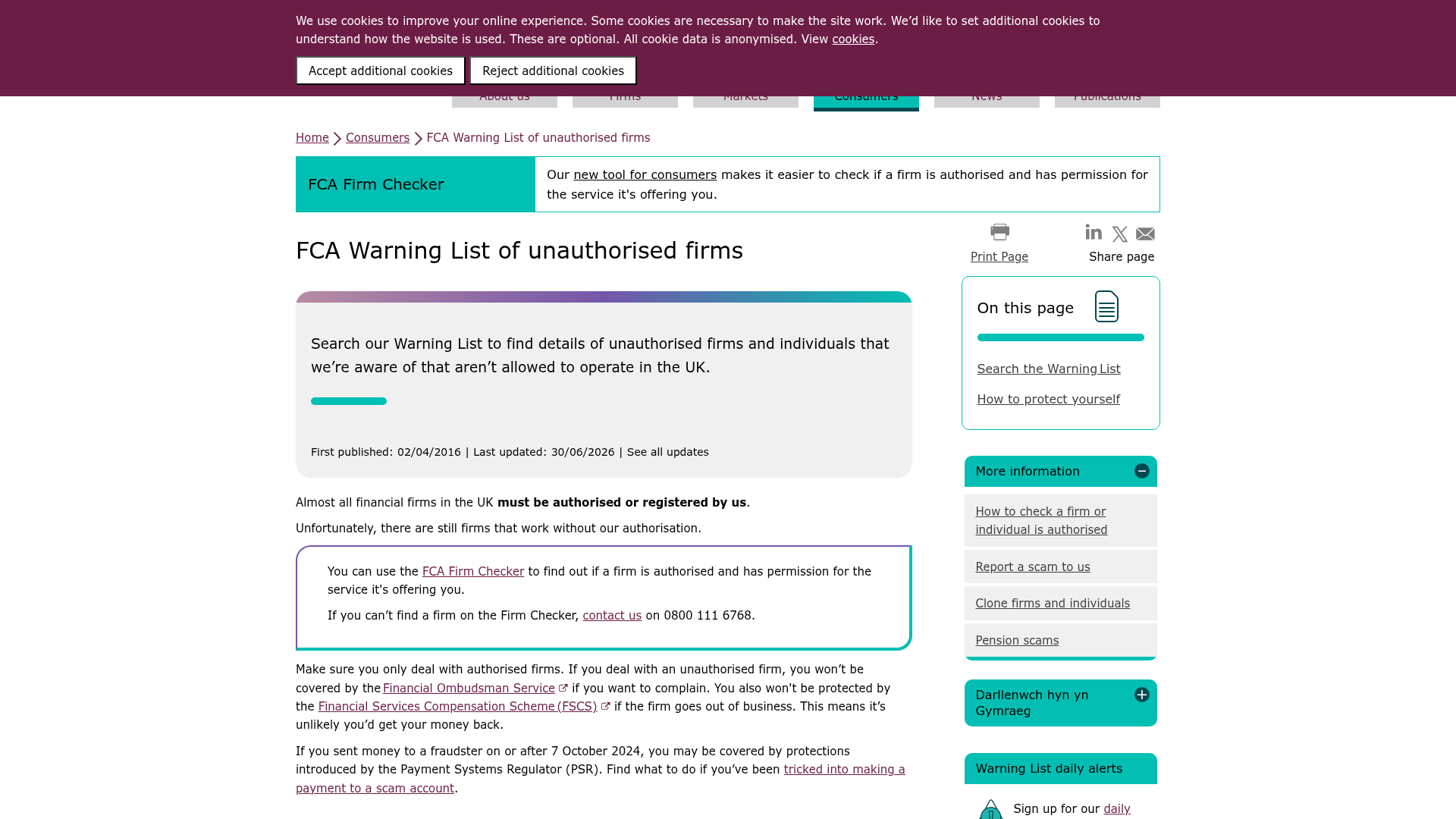
Crucially, always consult the FCA's Warning List of Unauthorised Firms (fca.org.uk/consumers/warning-list-unauthorised-firms). This list details firms that are operating without authorization or are known clone firms. If a firm you are researching appears here, it is a definitive warning against engaging with them. A firm appearing on this list should prompt you to cease all communication immediately. Even if a firm seems legitimate on first glance, a warning on this list overrides any other positive indicators and should be taken with extreme seriousness.
FSCS Eligibility and Investment Protection
For consumers in the UK, one of the most significant benefits of dealing with an FCA-authorized firm is access to the Financial Services Compensation Scheme (FSCS). The FSCS is the UK's statutory fund of last resort for customers of authorized financial services firms. If an authorized firm fails, and cannot meet its financial obligations, the FSCS can compensate eligible clients.
For investments, the FSCS protects up to £85,000 per person, per authorized firm. This limit applies to claims against firms offering products like stocks, bonds, unit trusts, and certain types of investment advice. It's critical to understand that this protection is specifically against the failure of the firm, not against investment losses due to market fluctuations or poor performance. If you invest in a stock that loses value, the FSCS will not compensate you. However, if your FCA-regulated broker, such as AvaTrade, were to become insolvent, your eligible funds held with them, up to £85,000, would be protected.
Crucially, FSCS protection only applies to firms authorized by the FCA. If a firm is registered offshore, even if it claims to serve UK clients, you will almost certainly not be covered by the FSCS. Always check the 'Does this firm have FSCS protection?' section on the FCA Register entry. This explicit confirmation can be found on the FCA Register page for each firm, often under the 'Customer Information' or 'Firm Details' tab. Do not assume protection based on a firm's marketing claims alone.
Beyond the FCA Register: Cross-Referencing Other Regulators
Many large, reputable brokers operate globally, holding licenses from multiple regulatory bodies. For instance, FOREX.com is regulated by the FCA for its UK operations, but also by the CFTC/NFA in the USA and ASIC in Australia. While a firm's multi-jurisdictional presence can indicate broader credibility, for a UK resident, its FCA authorization remains the most important safeguard.
You can cross-reference other regulators if a firm prominently displays them. For example, if a firm like XM claims regulation by CySEC (Cyprus Securities and Exchange Commission) for its European operations, visit the CySEC Regulated Entities Register (cysec.gov.cy/en-GB/entities/investment-firms/cypriot/) to verify this claim. Similarly, for Australian regulation, check ASIC's Professional Registers (asic.gov.au/online-services/search-asics-registers/).
Remember, an overseas license does not grant equivalent protection to an FCA license for UK clients. If you are a UK resident, a firm operating under, say, an ASIC license, does not typically offer you FSCS protection or oversight under UK law. While these other licenses primarily assess the firm's global standing, for your direct protection as a UK consumer, the FCA registration is the only one that truly matters.
When a broker lists multiple regulators, it's often a sign of a larger, more established entity. However, the specific regulatory entity serving your account dictates your protections. Ensure the entity you're dealing with is the FCA-regulated arm if you seek UK protections.
Selected Brokers and Their Multi-Jurisdictional Regulatory Presence
| Broker Name | FCA Status (for UK entity) | Other Key Regulators |
|---|---|---|
| Pepperstone | Authorised | ASIC (Australia), CySEC (Cyprus), DFSA (Dubai) |
| OANDA | Authorised | CFTC/NFA (USA), ASIC (Australia), MAS (Singapore) |
| FxPro | Authorised | CySEC (Cyprus), FSCA (South Africa), SCB (Bahamas) |
| eToro | Authorised | CySEC (Cyprus), ASIC (Australia), FinCEN (USA) |
| IC Markets | Not primarily FCA for retail UK (ASIC primary) | ASIC (Australia), CySEC (Cyprus), FSA (Seychelles) |
| Plus500 | Authorised | CySEC (Cyprus), ASIC (Australia), FMA (New Zealand) |
The 'Appointed Representative' Distinction
While most firms are directly authorized by the FCA, some operate as 'Appointed Representatives' (ARs). An AR is a firm or person who runs regulated financial services activities on behalf of a directly authorized firm, known as the 'Principal'. The Principal firm takes full responsibility for the AR's actions. If you are dealing with an AR, its details will also appear on the FCA Register, explicitly linked to its Principal firm. The register entry will clearly state that the firm is an 'Appointed Representative' and provide the details of its Principal.
This structure is common in specific sectors, such as financial advisory services or certain types of insurance. However, it's less common for direct-to-consumer CFD or forex brokers. If a firm offering these services claims to be an AR, you must verify both its status and the Principal firm's status and permissions. The Principal firm must have the necessary permissions to oversee the activities offered by its AR. For example, if an AR is offering investment advice, its Principal must be authorized for 'Advising on investments'.
The crucial aspect here is that the regulatory responsibility and FSCS protection ultimately lie with the Principal firm. You are relying on the Principal's authorization. Therefore, it is equally important to examine the Principal firm's full register entry, including its permissions and any restrictions, to ensure they cover the activities of the AR you are engaging with. This adds an extra layer to your verification process, but it is necessary for full assurance.
Offshore Licenses and Their Lack of UK Protection
Less experienced investors often miss a significant red flag: a firm targeting UK clients displays only an offshore license, such as from the Seychelles (FSA), Mauritius (FSC), or St. Vincent and the Grenadines (FSA SVG). While these jurisdictions have their own regulatory frameworks, they offer substantially less consumer protection than the FCA for UK residents. For instance, IC Markets and Exness both list an FSA (Seychelles) license among their registrations. While legitimate for clients in specific regions, this license provides no recourse under UK law for a UK-domiciled investor.
The FCA is unequivocal: if a firm targets UK consumers and offers regulated financial services, it must be authorized by the FCA. An offshore license means you forgo the regulatory oversight, dispute resolution mechanisms (like the Financial Ombudsman Service), and crucially, the FSCS protection offered by the UK regime. Should something go wrong, pursuing legal action or seeking compensation against an offshore entity from the UK can be extraordinarily difficult, costly, and often futile.
Some firms might present themselves ambiguously, implying a global presence with various licenses without clearly stating which entity serves UK clients. As a UK consumer, if the firm offering you services does not have a clearly identifiable, FCA-regulated entity, you are effectively trading outside the UK's protective financial perimeter. This is a worse option than dealing with an FCA-regulated entity because it exposes your capital to significantly higher risk with virtually no legal or compensatory recourse in the event of firm insolvency or malpractice.
Common Deceptive Tactics: A Practitioner's Insight
Fraudulent actors are constantly evolving their methods, but certain patterns persist. A common tactic is the 'cold call' or unsolicited email from an individual claiming to represent a reputable investment firm. This is often followed by high-pressure sales tactics, promises of unrealistic returns, and demands for quick decisions. This is the part most guides skip: when presented with a broker's 'regulatory page,' the most common mistake is trusting the links provided on that page rather than checking the official regulator's website directly. A fraudulent firm will always link back to its own fabricated verification page.
Another prevalent method involves 'boiler rooms' where operatives call potential victims from overseas, offering complex, opaque investments. These operations rarely have any legitimate regulatory standing. They frequently rely on victims not knowing how to verify their claims or being too intimidated to ask direct questions. Their websites might display logos of legitimate financial institutions or claim affiliations with well-known brokers, but a quick check on the FCA Register will reveal no trace of their authorization.
Finally, be wary of any firm that requests payment in unusual forms, such as cryptocurrency transfers to individual wallets, or pressure you to transfer funds quickly without allowing you time for due diligence. Legitimate FCA-regulated firms adhere to strict client money rules, holding funds in segregated accounts with reputable banks. Any deviation from standard banking practices should immediately raise a high level of suspicion. Your best defense is a proactive offense: assume every claim needs independent verification, especially before committing any funds. Report suspected fraud to Action Fraud (actionfraud.police.uk) in the UK or the FTC (reportfraud.ftc.gov/) in the US.
The page we check
This is the authority's own page, captured as we found it. Open it and run the same search yourself — nothing on this register replaces the source.
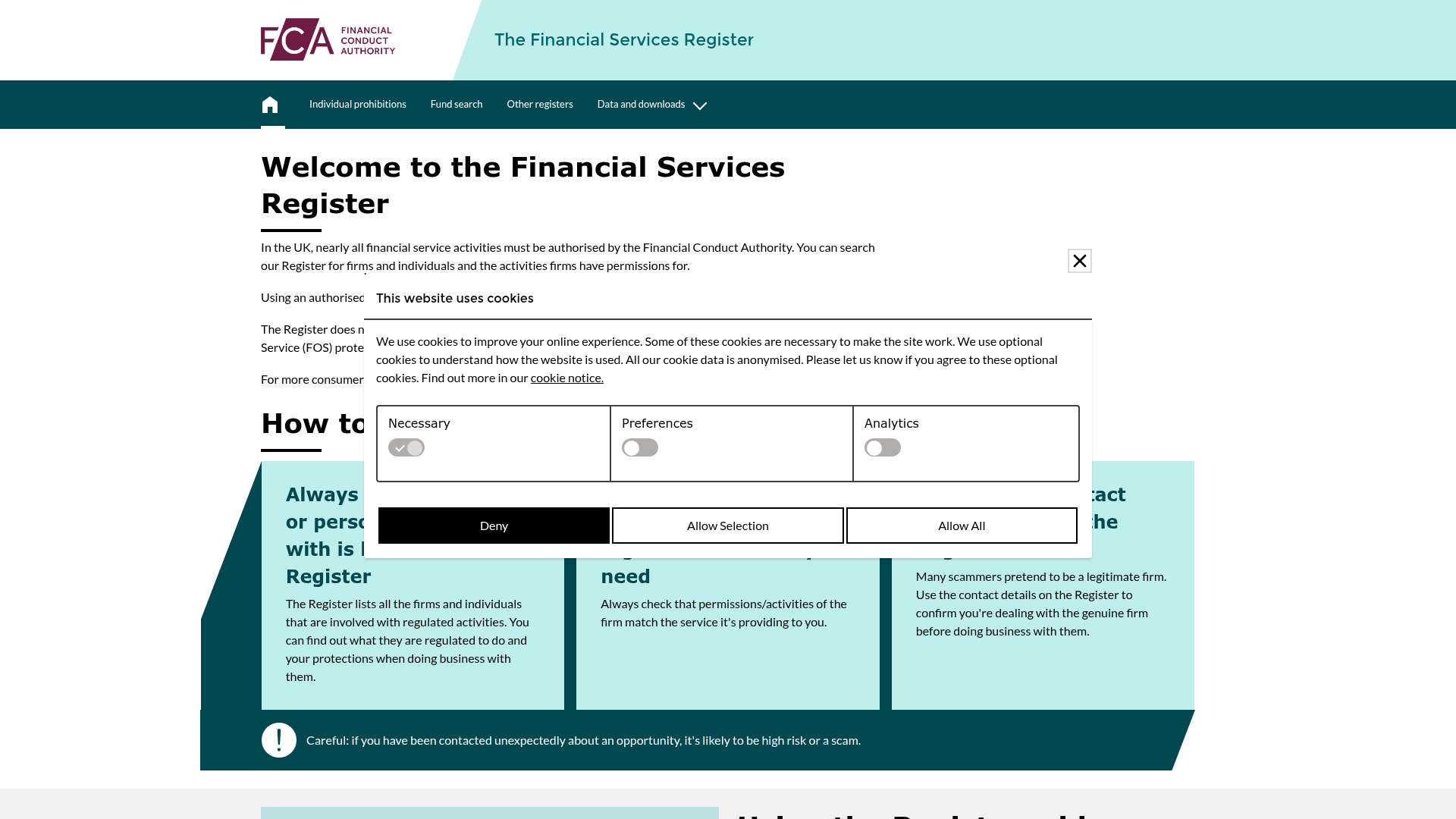
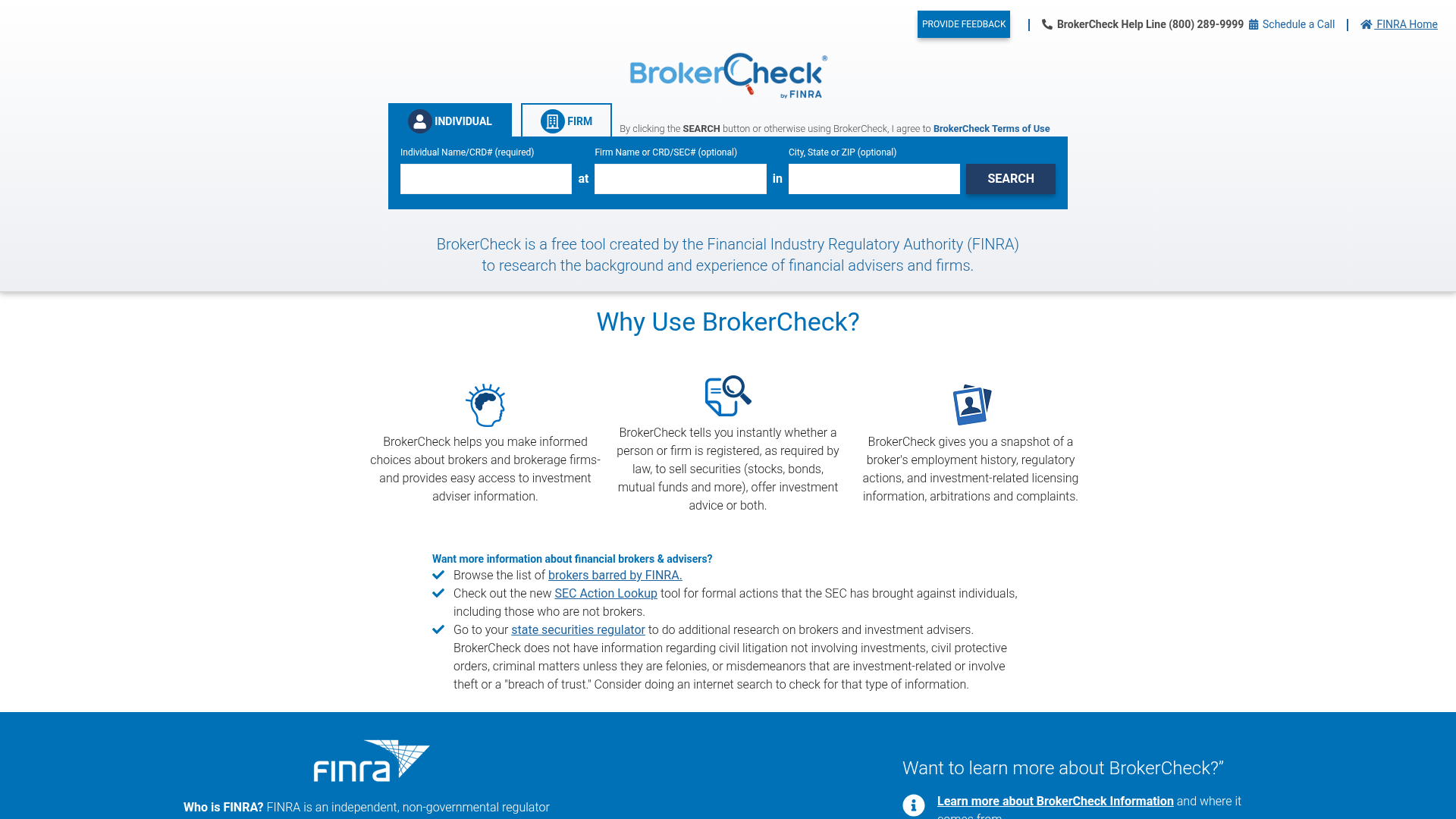
Other registers used in checks of this kind. Each opens the authority's own page.
Primary sources
Every claim above can be checked against the authority's own page. These open on the regulator's site, not ours.
- Financial Conduct Authority – Financial Services Registerregister.fca.org.ukhttps://register.fca.org.uk/
- FCA – Warning list of unauthorised firmsfca.org.ukhttps://www.fca.org.uk/consumers/warning-list-unauthorised-firms
- Financial Services Compensation Scheme (FSCS)fscs.org.ukhttps://www.fscs.org.uk/what-we-cover/investments/
- Action Fraud (UK) – reportingactionfraud.police.ukhttps://www.actionfraud.police.uk/
- FTC – Report fraudreportfraud.ftc.govhttps://reportfraud.ftc.gov/
Frequently asked
What is an FCA Firm Reference Number (FRN)?
An FRN is a unique seven-digit identification number assigned by the Financial Conduct Authority (FCA) to every firm or individual it authorizes. It is the most reliable way to search for a firm on the FCA Register and verify its identity.
What if a firm claims FCA regulation but I can't find it on the Register?
If you cannot find a firm on the official FCA Register using its exact legal name or FRN, it is highly likely that the firm is unauthorized. Immediately cease all communication and do not transfer any funds. You should also check the FCA's Warning List.
What is a 'clone firm' and how can I avoid one?
A 'clone firm' is a fraudulent entity that impersonates a legitimate, authorized firm by copying its name and sometimes its FRN. To avoid them, always verify the contact details (phone, email, address) on the FCA Register against what the firm provides, and never use contact details from the firm's website if they differ from the register.
Does FCA authorization guarantee my investment won't lose money?
No. FCA authorization means the firm is regulated and must adhere to specific rules and standards, offering certain protections. However, it does not protect you from investment losses due to market volatility or poor investment performance. It primarily protects against firm misconduct or insolvency.
How much compensation can I receive from the FSCS if an FCA-regulated firm fails?
The Financial Services Compensation Scheme (FSCS) protects eligible claims up to £85,000 per person, per authorized firm for investments. This applies if the firm becomes insolvent and cannot return your money, not if your investments simply lose value.
Is an offshore license sufficient for UK consumer protection?
No, an offshore license (e.g., from Seychelles, Mauritius) offers minimal to no consumer protection for UK residents. For UK-specific protections, including FSCS access and FOS dispute resolution, the firm or the entity serving you must be directly authorized by the FCA.