
Key points
- A VFSC 'dealer in securities' licence permits offering forex and CFDs but often comes with fewer investor protections than Tier-1 jurisdictions.
- Direct verification on the official VFSC registry is crucial, as some entities misrepresent their licensed status or the scope of their authorisation.
- Vanuatu does not operate a statutory investor compensation scheme akin to those found in the UK or Cyprus, limiting financial recourse.
- VFSC-licensed firms may offer significantly higher leverage, exceeding limits imposed by regulators like ESMA or ASIC, increasing risk for retail traders.
- Thorough due diligence extends beyond licence checks to include client fund segregation practices and transparent dispute resolution mechanisms.
- The absence of strong regulatory enforcement can expose clients to operational risks and limited avenues for effective complaint resolution.
The Starting Point: A Claim to Regulation
Imagine a company claiming to offer rapid profits from global markets, advertising 'fully regulated' status with an authority like the Vanuatu Financial Services Commission (VFSC). For many retail traders, this claim is a primary point of trust. However, the term 'regulated' can mean different things depending on the jurisdiction and the specific licence held. It is not enough to take a broker’s word or rely on a logo displayed prominently on their website. A critical first step for any prospective client is to independently verify any regulatory claim.
Firms offering contracts for difference (CFDs) and forex trading services often seek licences from a range of jurisdictions. Some, like the United Kingdom (FCA) or Australia (ASIC), are known for stringent oversight and strong investor protections. Others, such as Vanuatu, provide a different regulatory framework that may carry fewer investor safeguards. Understanding these distinctions is fundamental to assessing the actual level of protection offered.
This article outlines the precise steps for checking a 'dealer in securities' licence with the VFSC and, more critically, explains what such a licence genuinely implies for client safety and recourse. The process involves direct interaction with the official VFSC registry, a measure often overlooked but absolutely essential for informed decision-making.
Vanuatu's Financial Services Commission: A Closer Look
The Vanuatu Financial Services Commission (VFSC) is the primary regulator for non-banking financial services in the Republic of Vanuatu. Its mandate includes the registration and supervision of various entities, such as international companies, trusts, and financial service providers, including those classified as 'dealers in securities'. The VFSC aims to ensure a degree of orderly conduct within its jurisdiction, issuing licences and enforcing specific compliance requirements.
However, the VFSC's regulatory approach and the protections it affords differ materially from those of more established financial centres. For instance, its framework for client fund segregation, capital adequacy, and dispute resolution is not as prescriptive or as rigorously enforced as in jurisdictions with larger, more mature financial markets. This does not imply that VFSC-licensed entities are inherently problematic, but rather that the level of regulatory oversight and the potential for investor protection are distinct.
Clients should understand that while a VFSC licence indicates formal registration, it does not automatically guarantee the same level of client money protection, compensation schemes, or leverage restrictions that might be expected from regulators like the UK's FCA or Cyprus's CySEC. The VFSC operates under its own legal statutes, and these statutes reflect Vanuatu's specific economic and regulatory priorities, which may not align with the strong consumer protection models prevalent elsewhere.
Decoding the 'Dealer in Securities' Licence
The 'dealer in securities' licence is one of the most common types issued by the VFSC to firms that wish to offer trading services in instruments like forex and CFDs. Under the Dealers in Securities (Licensing) Act Cap. 70, this licence authorises an entity to deal in, arrange deals in, or manage securities. In practice, this often translates to providing platforms for retail clients to trade various financial products.
Crucially, the VFSC’s 'dealer in securities' framework historically has been less restrictive concerning aspects like leverage. While regulators in Europe (ESMA intervention) or Australia (ASIC) have capped retail CFD leverage at rates such as 1:30 or 1:50, a VFSC-licensed entity might offer significantly higher leverage, sometimes 1:500 or even more. This higher leverage amplifies both potential gains and, more importantly, potential losses for the retail investor.
The scope of instruments that can be offered under this licence can be broad, covering a range of asset classes. The absence of specific product intervention measures, common in other jurisdictions, means that a VFSC-licensed firm might offer products or features that are restricted elsewhere. This flexibility can be appealing to some providers and clients, but it places a greater onus on the individual investor to assess the inherent risks associated with such offerings.
Using the Official VFSC Registry for Verification
To ascertain whether a firm genuinely holds a 'dealer in securities' licence from the VFSC, direct verification via the official online registry is crucial. Simply trusting a website's claim or a scanned document can lead to exposure to unauthorised entities or 'clone firms' that mimic legitimate businesses. The VFSC maintains an accessible online database for this purpose.
Begin by visiting the official VFSC website. Look for a section explicitly labelled 'Registers,' 'Public Search,' or 'Financial Service Providers.' You will typically be prompted to enter the name of the company you wish to verify or, if available, its VFSC licence number. Ensure you use the exact registered name, as even minor discrepancies can yield no results. The search result should confirm the company's status, the type of licence held (e.g., 'Dealer in Securities'), and the date of issue and expiry. This is the only definitive way to confirm the licence.
It is important to note that the VFSC registry primarily confirms the existence of a licence. It does not provide an assessment of the firm's financial health, its business practices, or its dispute resolution history. That deeper investigation remains the responsibility of the prospective client. If a firm claims VFSC regulation but cannot be found on the official registry, or if the details do not match, this should serve as a significant warning sign.
This is the part most guides skip: always cross-reference the registered address and contact details on the VFSC registry with those provided by the broker. Discrepancies here can indicate a misleading operation, even if a licence appears to exist. Pay close attention to the licence status; 'lapsed' or 'suspended' are not equivalent to 'active'.
A VFSC 'dealer in securities' licence is a starting point, not the entire picture; prudent due diligence extends beyond merely confirming a firm’s regulated status.
Mei Tanaka
Steps for VFSC Licence Verification and Interpretation
Verifying a VFSC licence is a straightforward process, yet careful interpretation of the results is key. The table below outlines the necessary steps and what to look for when reviewing the information provided by the registry. This direct method protects against misrepresentation and offers the most accurate picture of a firm's regulated status in Vanuatu.
Once you have located the firm, confirm the 'Dealer in Securities' licence type. Also, check the effective and expiry dates to ensure the licence is current. An expired or revoked licence means the firm is no longer authorised to conduct such activities. If the firm is listed under a different licence type, it may not be authorised for the services it is offering. For instance, a firm with only a 'Company Formation Agent' licence cannot legitimately operate as a 'Dealer in Securities.'
Finally, make a note of the exact legal name and registration number. These details are critical for any future correspondence or inquiries with the VFSC, should they become necessary. While the desk will ask twice for precise details in any dispute, having them accurately recorded from the outset is a simple preventative measure that offers clarity. This diligence ensures you are dealing with the legally registered entity, not a fraudulent imitation.
Step-by-Step Guide to Verifying a VFSC Dealer in Securities Licence
| Step | Action Required | Expected Outcome | Key Information to Verify |
|---|---|---|---|
| 1 | Access the official VFSC website | Homepage with navigation options | Look for 'Registers' or 'Public Search' menu item. |
| 2 | Navigate to the 'Public Register' or 'Financial Service Providers' search tool | Search interface appears | Confirm it is the official VFSC domain. |
| 3 | Enter the company's full legal name or VFSC licence number | Search results display a list of entities or a single match | Use the exact name provided by the firm. |
| 4 | Locate the specific firm in the search results | Matching entry with company details | Verify the legal name, registration number, and address. |
| 5 | Examine the licence details for the selected firm | Licence type, status, issue date, expiry date | Confirm 'Dealer in Securities' type and 'Active' status. |
| 6 | Cross-reference all registry details with the firm's website information | Consistency in legal name, address, and licence number | Any discrepancies warrant further investigation or caution. |
Understanding Regulatory Differences: Tier-1 Regulators vs. VFSC
It is essential to understand that not all regulatory frameworks offer the same level of client protection. Comparing the VFSC with Tier-1 regulators like the UK's Financial Conduct Authority (FCA) or Australia's ASIC illustrates these differences starkly. These advanced jurisdictions impose stringent capital requirements, ensuring licensed firms maintain sufficient financial stability to absorb losses without jeopardising client funds.
Tier-1 regulators also mandate strict rules regarding client money segregation, often requiring client funds to be held in separate bank accounts from the firm's operational capital, typically with major banks. This provides a critical layer of protection, making it harder for firms to misappropriate client funds or for these funds to be seized in the event of the firm's insolvency. Jurisdictions like the UK and Cyprus offer statutory investor compensation schemes, such as the Financial Services Compensation Scheme (FSCS) or the Investor Compensation Fund (ICF), which can pay out claims up to a specified limit if a regulated firm fails.
In contrast, the VFSC's framework, while formal, does not typically include these specific compensation mechanisms or the same degree of prescriptive capital or client money handling rules. This means that if a VFSC-regulated firm were to become insolvent or engage in malfeasance, the avenues for recovering lost funds for a client could be significantly more limited and challenging. This distinction is not a judgment on the VFSC's mandate but a practical assessment of the protections available to the end investor.
Consequently, while a VFSC licence means a firm is registered and subject to some oversight, it does not equate to the full client protection offered by highly capitalised and stringently regulated jurisdictions.
Comparison of Key Investor Protection Features Across Regulatory Jurisdictions
| Regulatory Feature | VFSC (Vanuatu) | FCA (UK) / ASIC (Australia) |
|---|---|---|
| Investor Compensation Scheme | Generally not available | Yes (e.g., FSCS up to £85,000 / ASIC doesn't have a direct scheme but strong trust account rules) |
| Client Money Segregation | Guidelines exist, but enforcement and specifics may vary | Strictly mandated into separate, protected bank accounts with robust oversight |
| Leverage Restrictions (Retail CFDs) | Typically high (e.g., 1:500+) | Capped (e.g., 1:30 for major forex pairs under ESMA intervention) |
| Capital Requirements | Lower thresholds compared to Tier-1 | Substantially higher to ensure firm solvency and operational resilience |
| Dispute Resolution | Internal mechanisms, limited external recourse | Independent ombudsman services (e.g., Financial Ombudsman Service) |
| Regulatory Reporting Frequency | Less frequent, potentially less granular | Frequent and detailed financial and operational reporting |
The Absence of a Compensation Scheme
One of the most significant differences between a VFSC licence and those from jurisdictions like the UK or Cyprus lies in the presence—or absence—of a statutory investor compensation scheme. In the United Kingdom, for example, the Financial Services Compensation Scheme (FSCS) offers protection up to £85,000 per eligible person per firm if an authorised financial services firm fails or goes out of business. Similarly, Cyprus has the Investor Compensation Fund (ICF), which provides coverage up to €20,000.
These schemes act as a critical safety net, offering a measure of financial security to retail investors in the event of a firm’s collapse, regardless of its underlying financial health. The existence of such a scheme means that even if a broker becomes insolvent, clients have a defined avenue for potentially recovering a portion of their funds, up to the stipulated maximum. This provides a clear path for recourse that does not depend solely on the firm's internal liquidity or the lengthy process of insolvency proceedings.
In Vanuatu, such a government-backed, statutory investor compensation scheme does not exist for clients of VFSC-regulated 'dealers in securities'. This means that if a VFSC-licensed firm were to encounter severe financial difficulties or cease operations, clients would likely have very limited, if any, official recourse for recovering their invested capital. Any recovery would depend on the firm's assets during liquidation, a process that can be protracted and often yields minimal returns for unsecured creditors, which clients typically are. This is a critical consideration for anyone evaluating a firm regulated solely by the VFSC.
Beyond the Licence: What Else to Examine
While verifying a licence is foundational, prudent due diligence extends beyond merely confirming a firm’s regulated status. A VFSC licence, like any regulatory approval, is a starting point, not the entire picture of risk assessment. Investors must also scrutinise the operational aspects of the firm, paying close attention to how it handles client funds, its dispute resolution mechanisms, and its overall transparency. For example, how does the firm segregate client money from its operational capital? Are these funds held in reputable, Tier-1 banks?
Examine the firm's terms and conditions, particularly clauses related to withdrawals, fees, and complaint procedures. A firm that makes withdrawals difficult, imposes hidden charges, or has an opaque complaint process, even if regulated, warrants extreme caution. Look for evidence of independent audits and clear, publicly available financial statements, though these are less commonly mandated or accessible for VFSC-regulated entities compared to those in highly regulated jurisdictions.
Consider the firm's track record and reputation across independent review platforms, bearing in mind that online reviews can be manipulated. Seek objective reports and warnings from other international financial authorities. The presence of a VFSC licence does not negate the need for a full evaluation of these other factors. A licence only confirms legal authorisation; it does not guarantee ethical conduct or financial stability.
Broker Examples: A Look at Diverse Regulatory Structures
Examining established brokers provides insight into how firms operate under diverse regulatory structures. For instance, Pepperstone, headquartered in Melbourne, Australia, holds licences from multiple top-tier regulators including the FCA (UK), ASIC (Australia), and CySEC (Cyprus). This multi-jurisdictional approach allows them to cater to clients in various regions while adhering to the specific rules of each authority. Their site tagline, 'Australia's leading online forex and CFD broker', reflects their primary market and strong regulatory grounding.
Similarly, IC Markets, also from Sydney, Australia, is regulated by ASIC, CySEC, and the FSA (Seychelles). The inclusion of the FSA Seychelles indicates a strategy to serve clients from regions where Tier-1 regulation might be less accessible or where different trading conditions are preferred. XM, based in Limassol, Cyprus, operates under CySEC, ASIC, IFSC, and DFSA licences, again showcasing a global reach through a combination of stringent and less restrictive regulatory environments.
OANDA, with its headquarters in New York, USA, holds regulation from the FCA, CFTC/NFA, ASIC, IIROC, and MAS. This broad regulatory footprint with several top-tier authorities (including in North America and Singapore) reflects a commitment to strict compliance and investor protection in multiple key markets. These examples illustrate that reputable firms often seek regulation in jurisdictions known for their strong oversight, sometimes complementing this with licences from other regions to expand their client base. While no specific broker from our verified data uses a VFSC licence, the existence of brokers with varied regulatory lists highlights the strategic choices firms make regarding their operational jurisdictions.
Recourse and Risk: Practical Implications for Clients
When something goes wrong with a financial service provider—be it a technical malfunction, a dispute over trades, or even outright fraud—the level of regulatory protection significantly influences a client's practical recourse. With a firm regulated by a Tier-1 authority, there are typically established channels for complaints, such as an independent ombudsman service, and the regulator itself may intervene or impose penalties.
For a firm regulated solely by the VFSC, the path to dispute resolution can be considerably more challenging. While the VFSC does have a complaints procedure, its capacity for intervention and enforcement may not match that of larger, better-resourced regulators. If an issue escalates beyond direct communication with the firm, clients might find themselves having to pursue legal action in Vanuatu, which can be an expensive, time-consuming, and logistically difficult process for individuals located elsewhere. This is particularly true for smaller claim amounts, where the cost of litigation could easily outweigh the potential recovery.
Therefore, the practical implication is that a VFSC licence, while granting a firm legal authority, provides a weaker safety net for clients compared to more developed financial jurisdictions. The risk of encountering unresolved disputes, or of facing financial losses without clear avenues for compensation, is materially higher. This reality necessitates a higher degree of personal vigilance and risk assessment from the investor.
Protecting Your Capital: A Prudent Approach
The decision to engage with any financial service provider, especially one regulated in an offshore jurisdiction like Vanuatu, demands a meticulous and protective approach. The core instruction is unequivocal: conduct your own thorough due diligence, starting with official registry verification and extending to an understanding of the available investor protections.
Do not rely solely on marketing materials or third-party endorsements. Take the time to read the firm's legal documentation, paying particular attention to terms of service, client agreement, and privacy policy. If any aspect feels unclear or overly complex, seek independent financial or legal advice before committing funds. Remember that higher advertised leverage or bonus offers from such entities often come with commensurately higher risks and fewer safeguards. Your capital is your responsibility; protect it by verifying every claim and understanding every risk.
Finally, maintain accurate records of all communications, transactions, and agreements with the firm. This documentation will be invaluable should any dispute arise, providing concrete evidence to support your position. Prioritising these steps will allow you to make a more informed decision, aligning your risk tolerance with the actual level of protection provided by the regulatory environment.
The page we check
This is the authority's own page, captured as we found it. Open it and run the same search yourself — nothing on this register replaces the source.
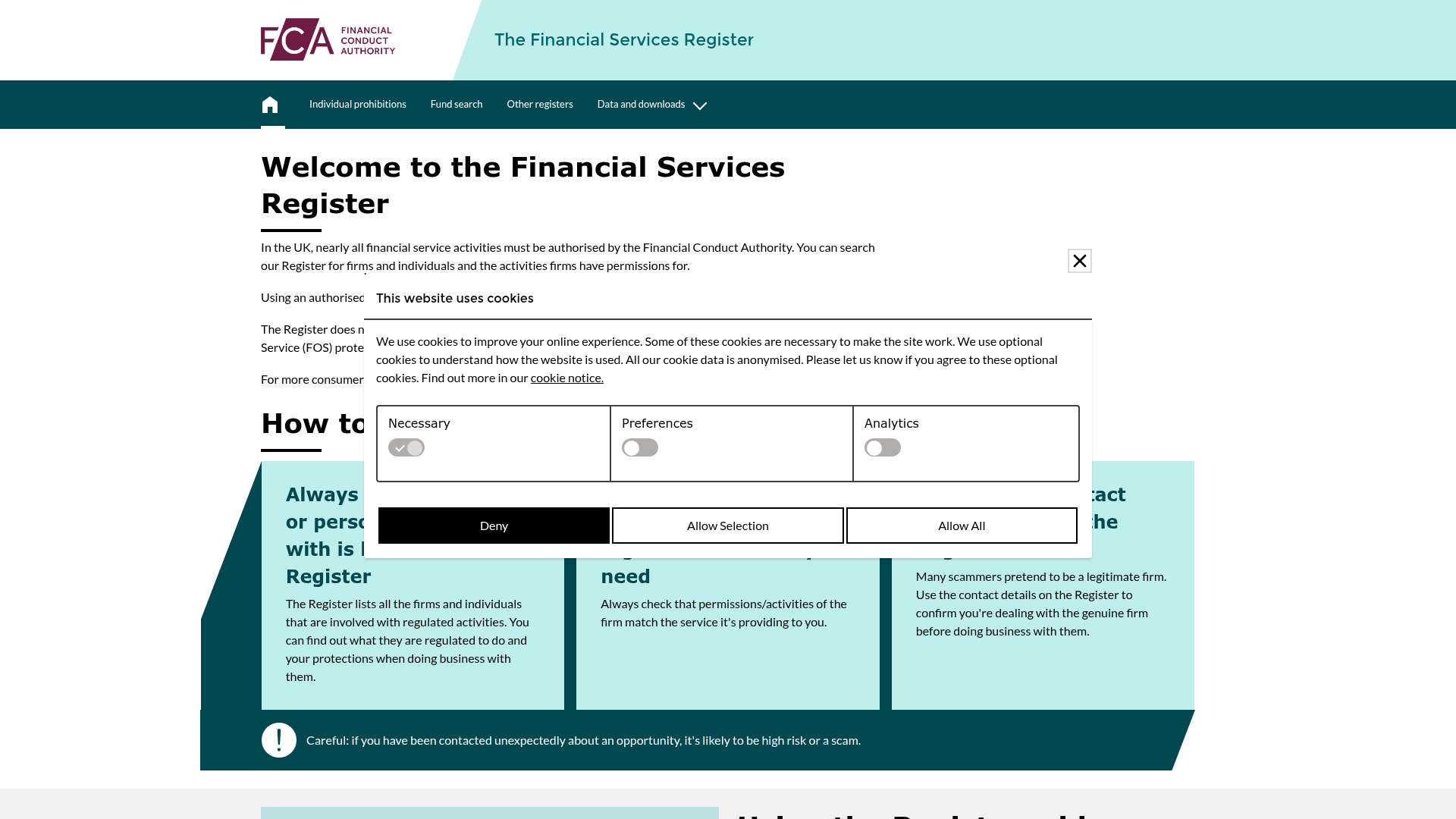
Other registers used in checks of this kind. Each opens the authority's own page.
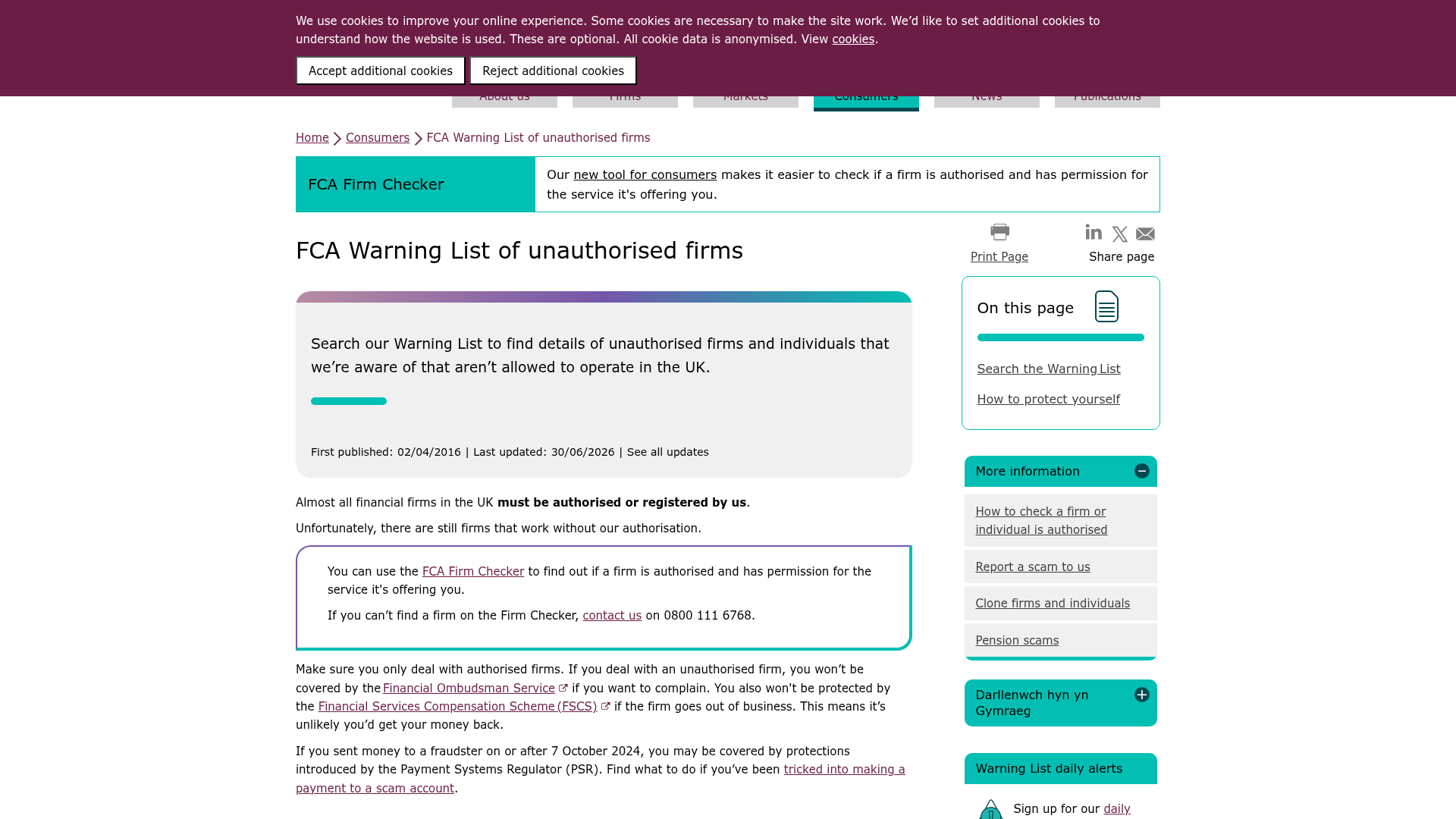
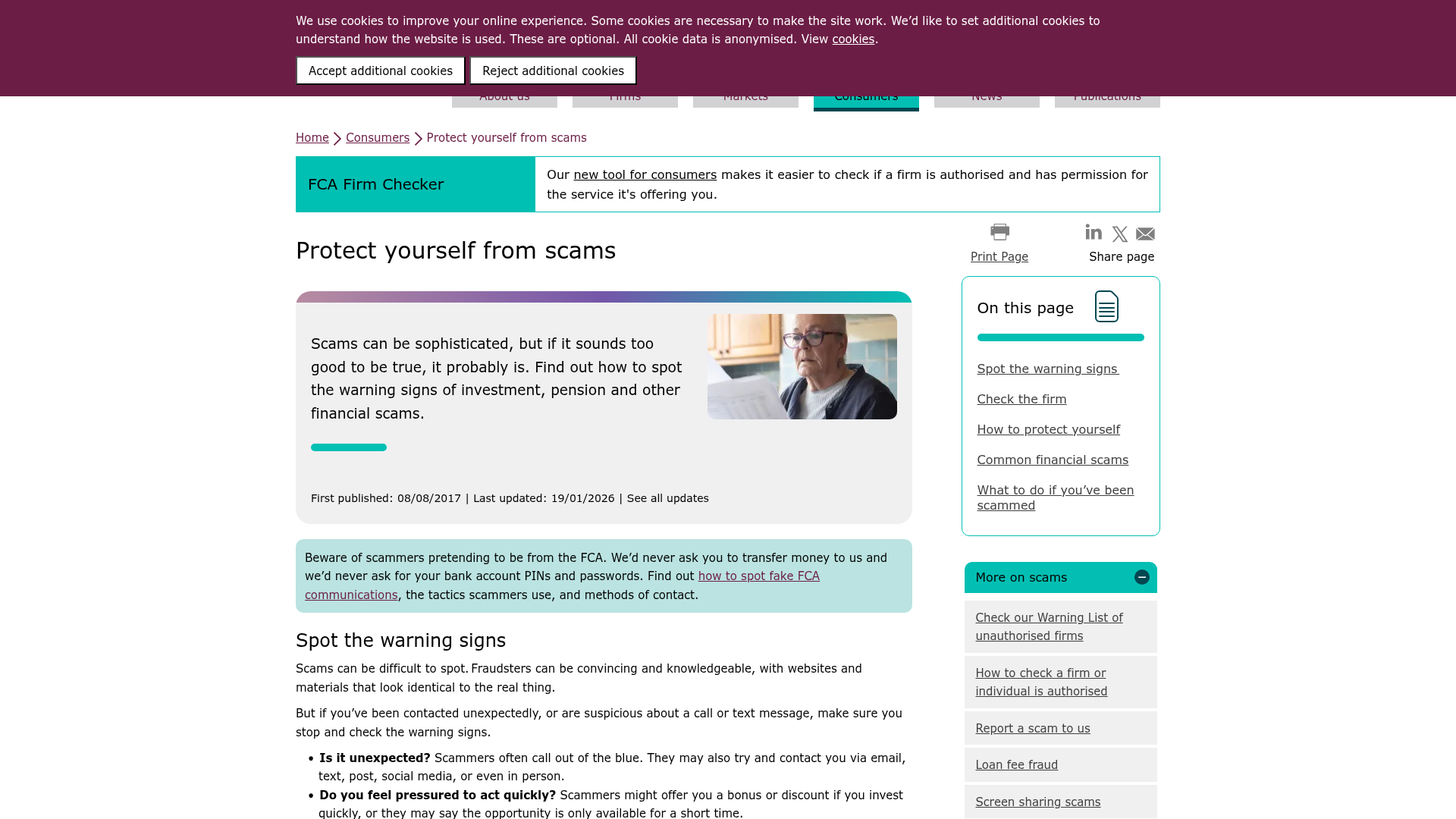
Primary sources
Every claim above can be checked against the authority's own page. These open on the regulator's site, not ours.
- Financial Conduct Authority — Financial Services Registerregister.fca.org.ukhttps://register.fca.org.uk/
- ASIC — Professional registersasic.gov.auhttps://asic.gov.au/online-services/search-asics-registers/
- CySEC — Regulated entities registercysec.gov.cyhttps://www.cysec.gov.cy/en-GB/entities/investment-firms/cypriot/
- ESMA — Product intervention on CFDsesma.europa.euhttps://www.esma.europa.eu/press-news/esma-news/esma-agrees-prohibit-binary-options-and-restrict-cfds-protect-retail
- Financial Services Compensation Scheme (FSCS)fscs.org.ukhttps://www.fscs.org.uk/what-we-cover/investments/
Frequently asked
What does a VFSC 'dealer in securities' licence permit a company to do?
This licence authorises a company to deal in, arrange deals in, or manage securities, which typically includes offering forex and Contracts for Difference (CFDs) trading services to clients. It confirms the firm's legal registration and authorisation to conduct such activities within Vanuatu's regulatory framework.
How can I verify if a broker truly holds a VFSC licence?
You must visit the official Vanuatu Financial Services Commission (VFSC) website and use their public register or financial service providers search tool. Enter the firm's exact legal name or licence number. Confirm the licence type ('Dealer in Securities') and its active status and validity dates directly from the registry.
Does a VFSC licence offer investor compensation if a firm fails?
No, Vanuatu does not have a statutory investor compensation scheme comparable to those in the UK (FSCS) or Cyprus (ICF). If a VFSC-licensed firm becomes insolvent, clients typically have very limited, if any, official recourse for recovering their funds through a compensation scheme.
Are there leverage restrictions for retail clients under VFSC regulation?
Generally, VFSC regulation does not impose the strict leverage restrictions seen in jurisdictions like Europe (ESMA) or Australia (ASIC). Firms licensed by the VFSC may offer significantly higher leverage (e.g., 1:500 or more) to retail clients, which can amplify both potential gains and losses.
What additional due diligence should I perform beyond checking the licence?
Beyond licence verification, investigate how the firm segregates client funds, its withdrawal policies, fee structures, and dispute resolution procedures. Review client agreements thoroughly and seek independent financial advice if any terms are unclear. Verify the firm's physical address and contact information against official records.
Is a VFSC licence as protective as one from the FCA or ASIC?
No, a VFSC licence offers a different level of protection compared to those from Tier-1 regulators like the FCA (UK) or ASIC (Australia). These advanced jurisdictions typically impose stricter capital requirements, mandated client money segregation in major banks, and offer investor compensation schemes, which are generally absent under VFSC regulation.