
Key points
- Always use the official MAS Financial Institutions Directory to confirm a firm's licensing status in Singapore.
- The MAS Investor Alert List identifies entities that are unlicensed but may appear to be operating in Singapore.
- Unlicensed firms, even if operating internationally, offer no local regulatory recourse for Singapore-based investors.
- Cross-verify contact details, website URLs, and physical addresses to detect 'cloned firms' impersonating legitimate entities.
- International alert portals, like IOSCO's, complement local checks for firms operating across borders.
- Reporting suspicious entities to MAS is a vital step in protecting the broader investor community.
The Concrete Reality of Financial Deception
Imagine receiving an unsolicited email promoting an investment opportunity with promised returns of 15% per month. The sender claims to be "Singapore Capital Ventures," a division of a well-known international bank, and their website looks polished and professional. Such pitches often feature simulated trading platforms that show impressive, fabricated profits, or they promise access to exclusive pre-IPO deals that simply do not exist. This scenario is not theoretical; it unfolds daily, trapping unwary individuals into schemes involving fake forex, cryptocurrency, or even traditional stock investments. The initial, most critical step against such overtures is direct verification. Singapore, as a global financial hub, attracts both legitimate enterprises and those intending to exploit its reputation. For anyone engaging with a financial entity here, or one purporting to serve Singaporean residents, the Monetary Authority of Singapore (MAS) provides indispensable public tools. These directories are not mere lists; they are active defenses designed to equip the public with verifiable facts. Their proper use can differentiate a genuine opportunity from a fabricated one, saving substantial capital and distress. Ignoring these official checks is akin to driving a car without brakes; the risks quickly become unacceptable, potentially leading to irreversible financial losses.
The MAS Financial Institutions Directory: Your First Verification Point
The primary resource for confirming the legitimacy of a financial institution in Singapore is the MAS Financial Institutions Directory, accessible via eservices.mas.gov.sg/fid. This online directory lists all financial institutions currently regulated by MAS. It provides granular detail about each entity, including its full legal name, MAS license number, the specific regulated activities it is permitted to conduct (e.g., fund management, capital markets services, financial advisory services), its official business address, and the validity period of its license.To use the directory, a person typically navigates to the website and enters either the firm's name, its MAS license number, or selects the specific activity they wish to verify. A successful search result will display the firm's details exactly as registered. For instance, if you are considering trading with OANDA, regulated by MAS, you would search for "OANDA Asia Pacific Pte. Ltd." and verify its Capital Markets Services Licence. This listing confirms its authorization to deal in capital markets products and provide financial advisory services concerning investment products, specifically for products like foreign exchange (FX) and derivatives. Other common license types include 'Fund Management Company' or 'Financial Adviser'. Crucially, if a firm claims to operate in Singapore but does not appear on this directory, it is operating without MAS oversight for its Singaporean operations. This absence means no regulatory protection from MAS for clients, even if the firm holds licenses in other jurisdictions. Always match the displayed details against the information the firm provides, paying close attention to legal names and addresses. Discrepancies, however minor, warrant immediate investigation, as even a slight variation can indicate a fraudulent imitation.
Decoding the MAS Investor Alert List
Complementing the Financial Institutions Directory is the MAS Investor Alert List (IAL). This list, unlike the directory, does not contain licensed entities. Instead, it identifies entities that MAS has reason to believe are unlicensed but may have been wrongly perceived as being licensed or regulated by MAS. This includes firms that might be making false claims of MAS regulation, or those targeting Singapore residents without the necessary local permits. The IAL is a proactive warning system. It serves as a public registry of cautionary notes, highlighting entities that may be conducting regulated activities without proper authorization, or misrepresenting their regulatory status. For example, an entry might state that "MAS has received information that [Company Name] is soliciting investments from the public in Singapore without holding a capital markets services licence," or "This entity wrongly claims to be licensed by MAS." A critical distinction here is between a firm simply not being on the licensed directory and a firm actively being flagged on the alert list. The latter indicates a higher level of concern from the regulator, often based on public complaints or MAS's own intelligence. While a firm not listed in the directory is simply unlicensed for Singapore operations, a firm on the IAL has actively drawn MAS's attention for potentially deceptive practices. Investors should always treat any firm on the IAL with extreme caution and avoid any engagement, regardless of how convincing their marketing or purported 'credentials' appear.
Beyond the Name: Verification in Practice
A firm's name alone is insufficient for verification. Sophisticated fraudsters often create "cloned firms," mimicking the identity of a legitimate, regulated entity. They might use a similar name, replicate a legitimate firm's website design, and even provide genuine-looking documentation. This is where meticulous cross-verification becomes essential.Begin by checking the website URL. Is it identical to the one listed on the official MAS directory? Often, cloned firms use slightly altered domains (e.g., mas-financial.com instead of masfinancial.com), or they might use a common top-level domain like .org or .net when the legitimate firm uses .com. Next, compare contact details. The phone numbers, email addresses, and especially the physical office address must match what MAS has on file. If the firm claims a Singapore address, a quick online map search can sometimes reveal it to be a residential property, a shared virtual office without proper staff, or even a non-existent location. Check the specific services offered. A legitimate firm regulated for capital markets products will not suddenly offer high-yield cryptocurrency investments without additional, distinct licensing, or offer guaranteed returns, which is typically forbidden under regulatory frameworks for investment products. This meticulous process is more involved than a simple name search, but it offers strong protection against increasingly sophisticated deception tactics. A firm that cannot be definitively identified through precise details on the MAS directory, or one with any mismatch, however small, should be treated as highly suspicious and avoided.
Key Differences in Verification Points for Legitimate vs. Suspicious Firms
| Verification Point | Legitimate Firm (MAS Licensed) | Suspicious/Cloned Firm |
|---|---|---|
| Entity Name | Exact match on MAS FID | Slight variation, misspelling, or added words |
| MAS Licence Number | Clearly displayed, verifiable on MAS FID | Absent, fake, or belonging to another entity |
| Website URL | Matches URL on MAS FID or reputable public record | Similar but altered, often with extra characters or different domain suffix |
| Contact Details | Phone, email, address match MAS FID | Mismatch with MAS FID, generic email addresses (e.g., Gmail) |
| Services Offered | Aligns precisely with MAS-approved activities | Offers high, guaranteed returns or exotic, unregulated products |
| Physical Address | Verifiable business premises in Singapore | Residential address, P.O. Box, or non-existent location |
Ignoring official checks is akin to driving a car without brakes; the risks quickly become unacceptable, potentially leading to irreversible financial losses.
Alan Reeve
The Limits of MAS Oversight
While MAS provides critical protection, its regulatory reach has specific boundaries. MAS primarily regulates financial activities and institutions within or targeting Singapore. This means a firm licensed by MAS is regulated for its operations in Singapore, under Singaporean law. However, many investment scams originate from entities operating entirely outside Singapore, often targeting Singaporean residents through online platforms or unsolicited contact. These foreign-based firms, even if they accept funds from Singapore, fall outside MAS's direct jurisdiction if they are not licensed or operating locally.This is the part most guides skip. If an entity is based in, say, Saint Vincent and the Grenadines, and claims to offer trading services to Singaporeans via an online portal, MAS cannot directly enforce its regulations against that entity. Any recourse for an investor would depend on the laws of the firm's home jurisdiction, assuming it is even regulated there, which is often not the case for illicit operations that strategically choose jurisdictions with minimal oversight. Even if a foreign entity holds a license in its home country, that license typically provides protection only to residents of that country. Your best defense, therefore, is to only deal with entities explicitly licensed and regulated by MAS for operations within Singapore. If considering a foreign-based entity, ensure it is supervised by a highly reputable Tier-1 regulator in its home country (e.g., FCA, ASIC, CFTC/NFA) and understand that your protections may be limited by international boundaries. The jurisdiction of incorporation matters profoundly for investor recourse.
Comparing Regulatory Reach: MAS, FCA, and ASIC
Understanding the scope of different regulators is crucial, particularly in a globalized financial environment. MAS, the Financial Conduct Authority (FCA) in the UK, and the Australian Securities and Investments Commission (ASIC) are all highly respected Tier-1 financial regulators. While their fundamental goals — protecting investors and maintaining market integrity — are similar, their specific purviews differ.MAS regulates financial services and markets in Singapore. Its directives are legally binding for entities operating within its jurisdiction. Similarly, the FCA supervises firms operating in the UK, and ASIC oversees those in Australia. A firm like OANDA, for instance, holds licenses with MAS for its Asia Pacific operations, with the FCA for its UK entity, and with ASIC for its Australian activities. This multi-jurisdictional licensing means clients engaging with OANDA through its Singaporean entity are protected by MAS regulations, while those through its UK entity fall under FCA rules.However, a broker being regulated by ASIC does not automatically extend ASIC's protection to a Singaporean resident trading with that broker's non-Australian entity. For example, if an unregulated offshore entity claims to be part of a group that includes a legitimate ASIC-regulated firm, the client of the offshore entity receives no ASIC protection. This regulatory segmentation is often exploited by illicit operators who claim association with legitimate, regulated groups but direct clients to an unregulated offshore branch. Always confirm which specific entity within a group is serving you and by which regulator it is supervised for that specific service.
Select Brokers and Their Regulatory Status Across Key Jurisdictions
| Broker | Headquarters | MAS Regulation (Singapore) | Other Tier-1 Regulation Examples |
|---|---|---|---|
| Pepperstone | Melbourne, Australia | No | FCA (UK), ASIC (Australia), CySEC (Cyprus) |
| IC Markets | Sydney, Australia | No | ASIC (Australia), CySEC (Cyprus) |
| XM | Limassol, Cyprus | No | CySEC (Cyprus), ASIC (Australia), DFSA (UAE) |
| OANDA | New York, USA | Yes (OANDA Asia Pacific Pte. Ltd.) | FCA (UK), CFTC/NFA (USA), ASIC (Australia) |
| FOREX.com | New Jersey, USA (StoneX) | No | CFTC/NFA (USA), FCA (UK), ASIC (Australia) |
| FxPro | London, UK | No | FCA (UK), CySEC (Cyprus), FSCA (South Africa) |
| eToro | Tel Aviv, Israel | No | FCA (UK), CySEC (Cyprus), ASIC (Australia) |
The True Cost of Neglecting Due Diligence
The financial and emotional toll of engaging with an unlicensed or fraudulent entity is often profound and long-lasting. Victims typically face complete loss of invested capital, as these operators rarely have assets that can be legally recovered. Beyond the immediate monetary loss, there is the time and effort spent pursuing recovery, often a fruitless endeavor. The process involves filing police reports, engaging with lawyers (sometimes at additional expense), and dealing with the emotional stress of betrayal and financial hardship. The average reported loss in investment scams can range from a few thousand dollars to hundreds of thousands, with recovery rates being notoriously low, often below 10% for international scams. This shows that a few minutes spent verifying an entity upfront can prevent months or years of financial and emotional strain. The lack of an investor compensation scheme for dealings with unlicensed entities in Singapore means your capital is entirely exposed. Once funds are transferred to an unregulated entity, their recovery becomes a complex international legal challenge with low odds of success.
Proactive Measures for Investor Protection
Beyond checking regulatory registers, prudent investors adopt several proactive habits to protect their capital. A fundamental principle is to thoroughly understand any investment product before committing funds. If the offer seems too good to be true, it almost certainly is. High, guaranteed returns are a classic hallmark of fraudulent schemes, as all legitimate investments carry risk. Secondly, never provide personal financial details, account numbers, or passwords in response to unsolicited calls, emails, or messages. Legitimate financial institutions do not typically initiate contact in this manner for account sensitive information.Independent research extends to reading reviews, but with caution, as fake reviews are prevalent. Look for credible financial news sources, verified consumer protection websites, and official regulatory warnings. Always be suspicious of pressure tactics that demand immediate action or large transfers of funds. Take your time. Consult a licensed financial advisor if you are unsure. This layered approach to due diligence significantly reduces vulnerability to deceptive practices.
Reporting Suspicious Entities
Should you encounter a financial firm that appears to be operating without the necessary MAS license, or one making misleading claims, reporting it is a critical step. This action not only protects you but also contributes to safeguarding the wider investing public. MAS provides avenues for the public to submit information about suspicious financial activities or entities. Typically, this involves completing an online form on the MAS website, providing details such as the firm's name, website, contact information, and a description of the suspicious activity.When making a report, include all available evidence: screenshots of communications (emails, chat logs, social media posts), website links, transaction records (bank statements, transfer confirmations), and any other relevant documentation that substantiates your concerns. The more detailed your evidence, the more effectively MAS can investigate and take action. While MAS does not provide individual updates on every report, your information is vital for their intelligence gathering and enforcement efforts, helping to build cases against illicit operators and update the Investor Alert List. For cases involving actual financial loss due to fraud, a report should also be filed with the Singapore Police Force. They possess the investigative powers to pursue criminal charges, though recovery of funds remains challenging, especially if the perpetrators are operating internationally and have moved funds across multiple jurisdictions. The police report documents the crime, which can be crucial for any potential legal or insurance claims. Early and thorough reporting is always advised.
International Cooperation and the IOSCO Investor Alerts Portal
The global nature of financial markets means that vigilance often needs to extend beyond national borders. The International Organization of Securities Commissions (IOSCO) maintains an Investor Alerts Portal, a valuable resource for checking warnings issued by securities regulators worldwide. This portal aggregates alerts from numerous national regulators, providing a centralized point of reference for firms that have been flagged as unlicensed or suspicious in various jurisdictions.The IOSCO portal (iosco.org/investor_protection/?subsection=investor_alerts_portal) allows you to search for firms across multiple regulatory alerts simultaneously. For instance, if a firm is based in Cyprus but targeting investors in Singapore and also appears on the FCA's warning list, the IOSCO portal can help you discover this broader pattern of concern. It acts as a global cross-reference tool. However, it is important to remember that not every suspicious firm will appear on the IOSCO portal, particularly newer or smaller operations. Its value lies in identifying firms that have already drawn the attention of at least one international regulator. Using this portal in conjunction with MAS's local directories offers a more complete picture of a firm's global regulatory standing and potential risks. It serves as an additional layer of protection, indicating a firm's reputation across the broader financial community.
The page we check
This is the authority's own page, captured as we found it. Open it and run the same search yourself — nothing on this register replaces the source.
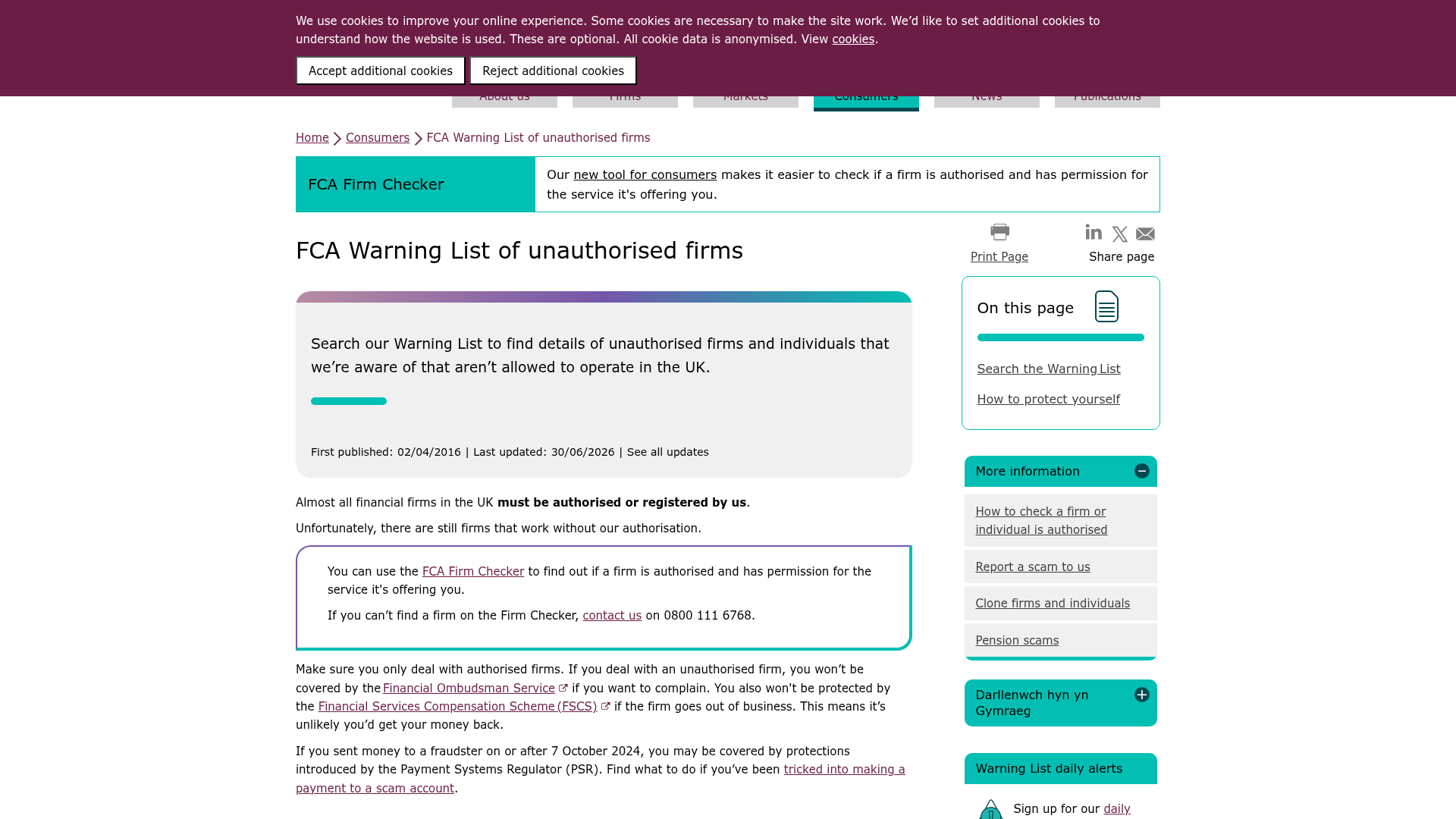
Other registers used in checks of this kind. Each opens the authority's own page.
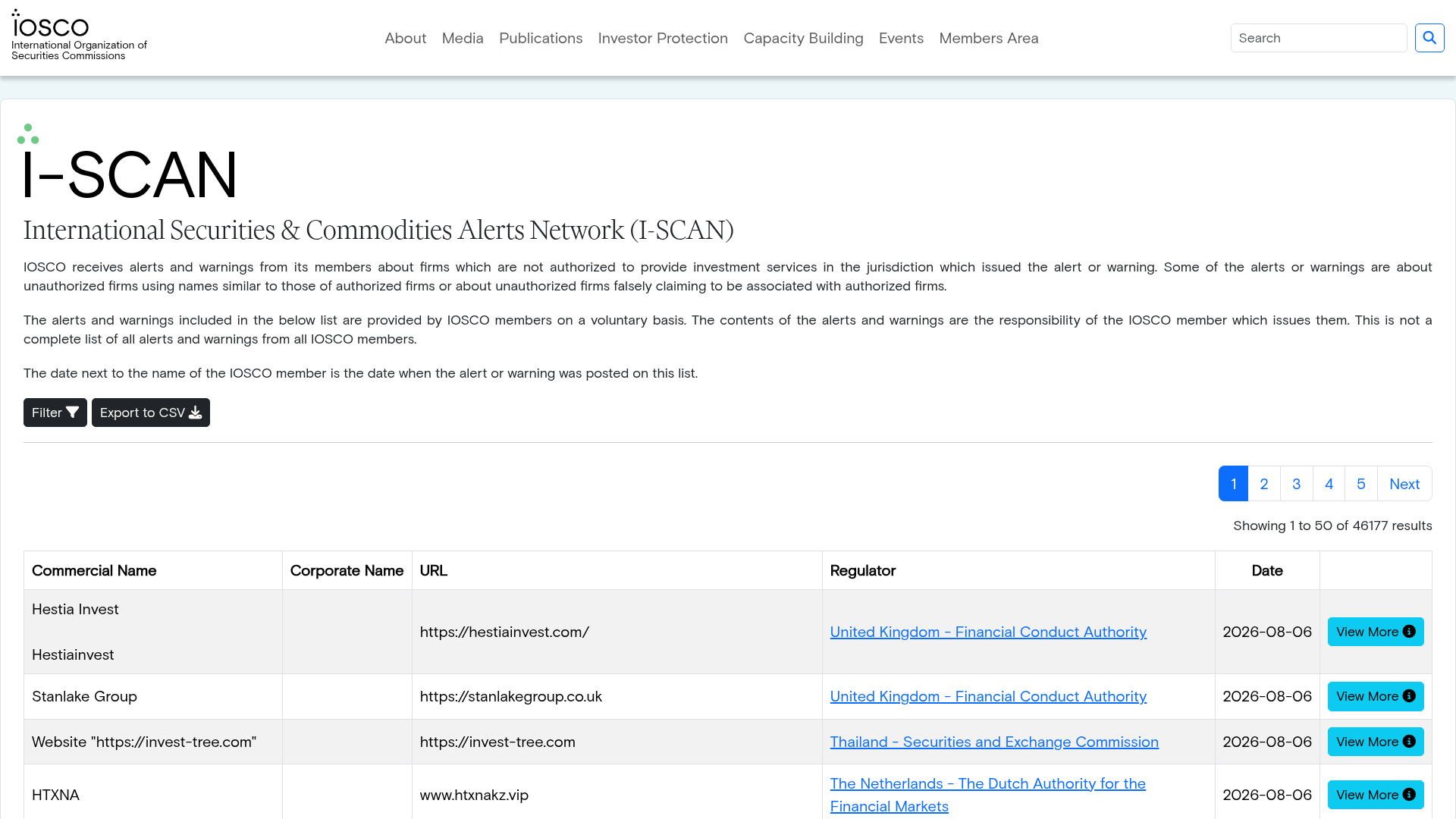
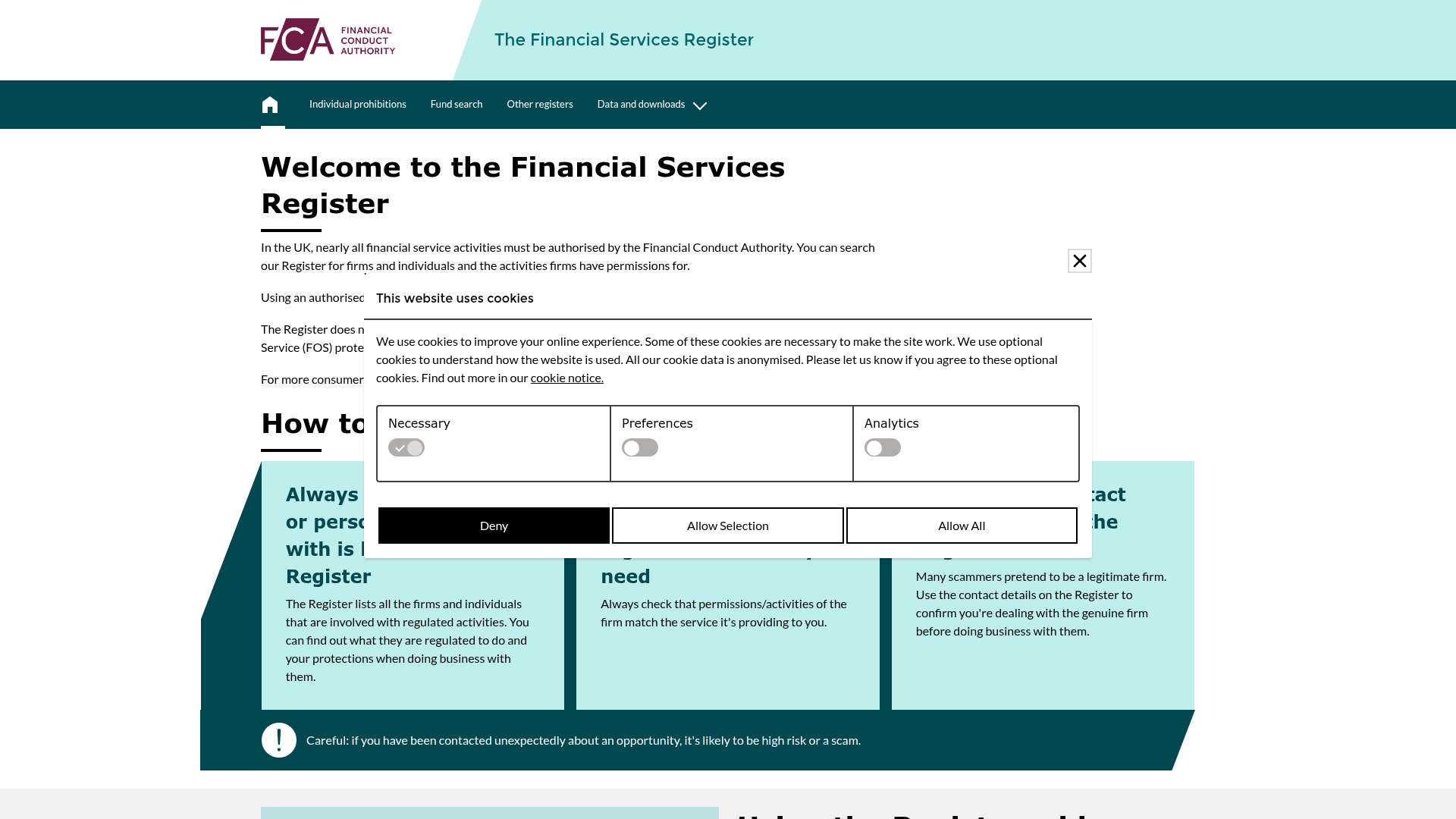
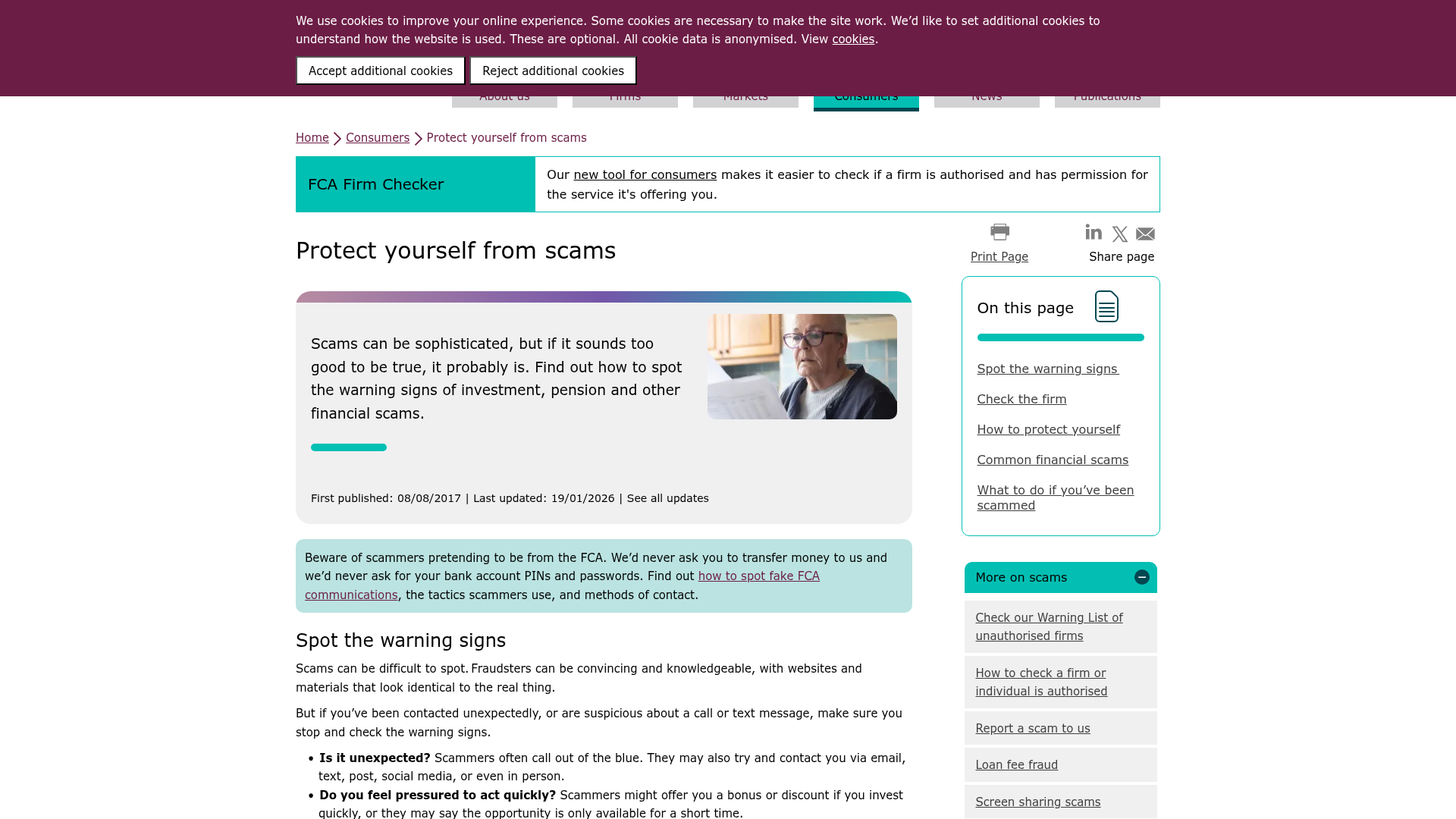
Primary sources
Every claim above can be checked against the authority's own page. These open on the regulator's site, not ours.
- MAS — Financial institutions directoryeservices.mas.gov.sghttps://eservices.mas.gov.sg/fid
- FCA — Warning list of unauthorised firmsfca.org.ukhttps://www.fca.org.uk/consumers/warning-list-unauthorised-firms
- IOSCO — Investor alerts portaliosco.orghttps://www.iosco.org/investor_protection/?subsection=investor_alerts_portal
- CFTC — Customer advisories on fraudcftc.govhttps://www.cftc.gov/LearnAndProtect/AdvisoriesAndArticles/index.htm
- Action Fraud (UK) — reportingactionfraud.police.ukhttps://www.actionfraud.police.uk/
Frequently asked
What is the main difference between the MAS Financial Institutions Directory and the Investor Alert List?
The Financial Institutions Directory lists all entities licensed and regulated by MAS in Singapore. In contrast, the Investor Alert List identifies unlicensed entities that MAS has reason to believe are wrongly perceived as licensed or are targeting Singapore residents deceptively.
If a firm isn't on the MAS directory, does that automatically mean it's a scam?
Not necessarily. It means the firm is not licensed by MAS for operations in Singapore. While many scams are unlicensed, some legitimate foreign firms may simply not hold a Singapore license, meaning you receive no local MAS protection. It is a significant red flag requiring further caution.
Can I recover my money if I invest with an unlicensed firm mentioned on the MAS Investor Alert List?
Recovery is extremely difficult and unlikely. MAS does not provide a compensation scheme for losses incurred with unlicensed entities. Your recourse would depend on the laws of the firm's actual jurisdiction, which for fraudulent entities, is often minimal.
How often is the MAS Investor Alert List updated?
The MAS Investor Alert List is updated regularly, often as new information or complaints are received and verified by the Authority. It's advisable to check the list frequently if you are considering engaging with a new financial entity.
Should I rely solely on the MAS directories for verification?
No. While MAS directories are the primary and most crucial step, you should also cross-verify details like website URLs and contact information, check international alert portals like IOSCO's, and conduct independent research to guard against sophisticated cloned firms.
What should I do if a firm claims to be regulated by MAS but I can't find them on the directory?
Do not engage with the firm. First, ensure you are searching the official MAS Financial Institutions Directory with the firm's exact legal name. If they are still not found, report the firm to MAS through their official channels, providing all available details.