
Key points
- pipvet.com's watchlist requires concrete, verifiable evidence from official sources or substantiated patterns of user complaints.
- Initial verification involves cross-referencing a firm's claimed licenses against official national and international regulatory registers.
- Official warning lists from regulators like the FCA and CFTC are primary indicators of concerns about a firm's operations.
- Unlicensed activity, especially when targeting specific jurisdictions, is a significant trigger for watchlist inclusion.
- Client fund segregation and access to investor compensation schemes are critical protections, and their absence raises immediate concerns.
- Firms operating from jurisdictions with minimal regulatory oversight are subject to heightened scrutiny for transparency and operational integrity.
The Silent Threat of Unverified Operators
A seemingly innocuous banner advertisement might promise 'unlimited returns' or 'guaranteed profits' with a trading platform. These claims, often presented with sophisticated branding and testimonials, frequently originate from entities operating without proper authorization or oversight. For a retail investor, distinguishing a legitimate, regulated broker from an unregulated imposter is not a matter of intuition; it requires a systematic process of verification. Simply taking a firm's website claims at face value is a dangerous approach. pipvet.com's watchlist exists precisely to highlight firms where verifiable evidence points to operations that may place client funds at undue risk. We do not rely on anecdotal reports alone; our process demands concrete, checkable facts.
Our commitment is to precision over presumption. While we understand that a mere accusation, without substantiation, can unjustly harm a legitimate business, we also recognize that a firm operating under false pretenses or in violation of regulatory norms can inflict significant financial damage on individuals. The bar for inclusion on our watchlist is high, reflecting the serious implications for both the firm and the investing public. This standard is not arbitrary; it is built on a framework of public data, regulatory pronouncements, and a careful aggregation of consistent, verifiable user experiences. Our aim is to provide clarity in a sector often clouded by misinformation.
The Foundational Layer: Official Regulatory Registrations
The first and most critical step in assessing any financial firm is to confirm its regulatory licensing. A legitimate broker must be authorized by a financial authority in the jurisdiction where it offers services. This isn't a 'nice to have'; it's a fundamental requirement. We begin by cross-referencing a firm's claimed licenses against the official, publicly accessible registers of the relevant regulatory bodies. For instance, if a broker claims to be regulated by the UK's Financial Conduct Authority (FCA), we search the FCA's Financial Services Register using the firm's legal entity name and registration number. The absence of a matching entry, or a mismatch in details, immediately triggers a flag.
It is crucial to understand that simply having a registration in one jurisdiction, for example, by the Seychelles Financial Services Authority (FSA), does not automatically authorize a firm to solicit clients in, say, the European Union or Australia without additional, specific licenses from CySEC or ASIC, respectively. This is the part most guides skip: a firm's global presence often means multiple, distinct regulatory authorizations are required. We assess whether the claimed licenses correspond to the regions where the firm actively markets and onboards clients. Any discrepancy here forms a key piece of evidence for a potential watchlist entry.
Primary Regulatory Verification Portals for Retail Forex/CFD Brokers
| Regulatory Authority | Jurisdiction | Verification Portal | Key Information to Search |
|---|---|---|---|
| Financial Conduct Authority (FCA) | United Kingdom | https://register.fca.org.uk/ | Firm reference number (FRN), legal entity name |
| Australian Securities and Investments Commission (ASIC) | Australia | https://asic.gov.au/online-services/search-asics-registers/ | Australian Company Number (ACN), Australian Business Number (ABN), name |
| Cyprus Securities and Exchange Commission (CySEC) | Cyprus | https://www.cysec.gov.cy/en-GB/entities/investment-firms/cypriot/ | License number, legal entity name |
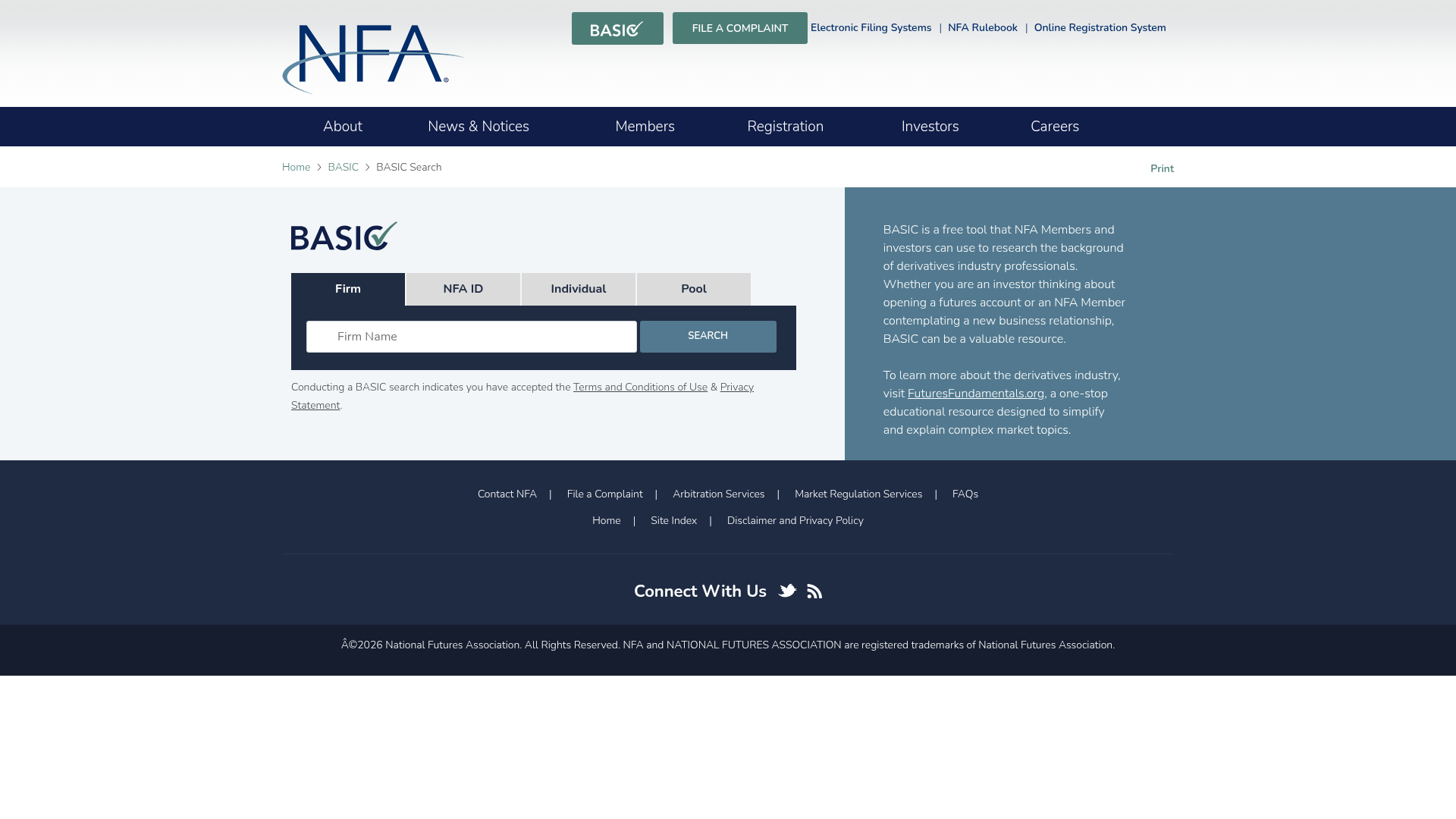
| Commodity Futures Trading Commission (CFTC)/National Futures Association (NFA) | United States | https://www.cftc.gov/check | NFA ID, firm name |
Official Warning Lists and Public Enforcement Actions
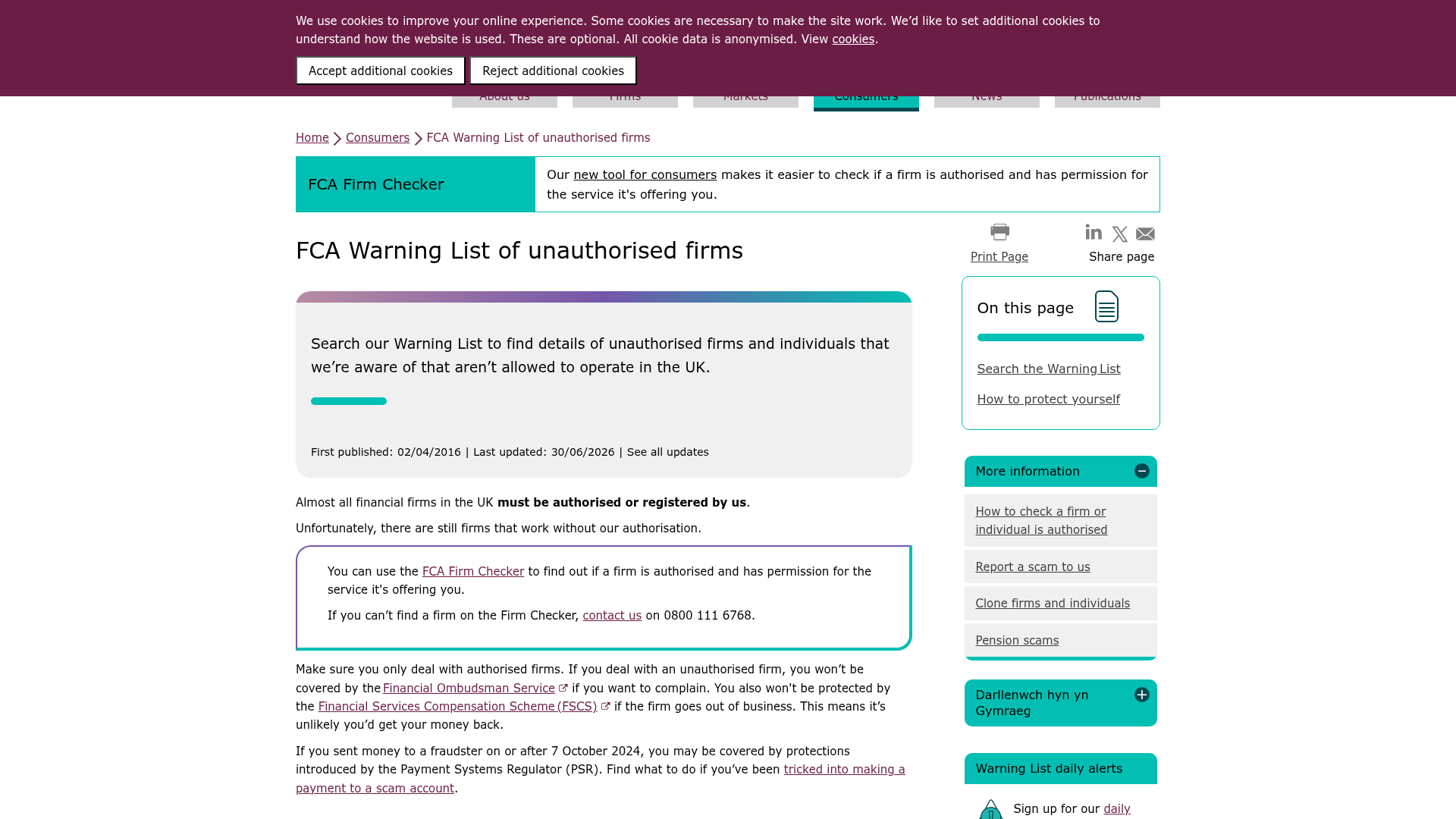
Beyond simply checking registration, we actively monitor the public warning lists issued by established financial regulators. These lists are explicit declarations from authorities that certain firms are operating without authorization, engaging in suspicious activities, or falsely claiming regulatory status. Examples include the FCA's Warning List of Unauthorised Firms and the CFTC's Registration Deficient (RED) List. These are not mere suggestions; they are official advisories grounded in regulatory investigations.
A firm's appearance on one of these lists represents a substantial, verifiable piece of evidence for pipvet.com. We also track public enforcement actions, sanctions, and cease-and-desist orders issued by regulators. These actions, often detailing specific violations like illicit soliciting of clients or operating without a license, provide irrefutable proof of regulatory non-compliance. Our review process prioritizes these official pronouncements, as they come directly from the bodies tasked with protecting the public interest. It is a fundamental disservice to investors to ignore these direct warnings, and we ensure they are centrally weighted in our assessment.
Aggregating Consistent Patterns of User Reports
While individual complaints can sometimes be isolated incidents or misunderstandings, a consistent pattern of similar user reports across different channels can indicate systemic issues. We meticulously aggregate reports from various sources, including direct submissions to pipvet.com, reports to fraud prevention bodies like the FTC (via reportfraud.ftc.gov) or Action Fraud (actionfraud.police.uk), and public forums. Our focus is on identifying recurring themes: inability to withdraw funds, sudden changes in trading conditions, aggressive marketing tactics, or refusal to honor profit claims.
Before considering these for watchlist inclusion, each pattern must be evaluated for its consistency and the potential for independent verification. For instance, if multiple users from different regions report identical issues with withdrawal requests that contradict the firm's stated policy, and these reports align with a lack of proper regulatory oversight, the aggregated weight of this evidence becomes significant. This process is not about judging individual grievances but about detecting systemic operational failures or predatory practices that affect a broader client base.
Our watchlist entry demands concrete, checkable facts from official sources, combined with aggregated patterns of verifiable user experience, not anecdotal reports.
Mei Tanaka
The Illusion of Regulation: Offshore Jurisdictions and Shell Entities
Many firms that ultimately appear on watchlists often operate from jurisdictions known for lax regulatory enforcement or minimal oversight requirements. While a license from an entity like the Financial Services Authority (FSA) of Seychelles or the Securities Commission of The Bahamas (SCB) is a valid registration for operations within that specific territory, it offers considerably less investor protection than licenses from tier-one regulators such as the FCA, ASIC, or CySEC. The problem arises when these firms actively solicit clients in highly regulated markets without obtaining the necessary local licenses.
We examine not only where a firm is registered but also where it operates and markets. A firm headquartered in Cyprus (like Exness) with a CySEC license might also hold an FSA (Seychelles) license. This is common. However, a firm with only an FSA (Seychelles) license that aggressively targets clients in Germany or France, without BaFin or AMF authorization, is engaging in unlicensed activity. This practice, often termed 'jurisdiction shopping,' allows firms to bypass stringent consumer protection rules, including leverage restrictions (e.g., capped at 1:30 for retail clients under the ESMA intervention) and mandatory investor compensation schemes. Operating without proper local authorization, regardless of an offshore registration, is a primary trigger for our watchlist.
Examples of Broker Regulatory Footprints and Jurisdictional Reach
| Broker (Example) | Headquarters | Tier-1 Regulators | Other Regulators (Lower Tier/Offshore) | Comment on Operations |
|---|---|---|---|---|
| Pepperstone | Melbourne, Australia | FCA, ASIC, CySEC, BaFin | DFSA, CMA, SCB | Maintains strong tier-1 presence, also serves other regions via diverse licenses. |
| XM | Limassol, Cyprus | CySEC, ASIC, DFSA | IFSC | Combines EU/AU regulation with an offshore entity for broader market access. |
| IC Markets | Sydney, Australia | ASIC, CySEC | FSA (Seychelles) | Australian HQ, strong EU/AU regulatory base, also utilizes offshore for flexibility. |
| OANDA | New York, USA | FCA, CFTC/NFA, ASIC, IIROC, MAS | None listed as 'other' | Globally recognized, robust tier-1 regulatory coverage across key markets. |
Client Fund Security: Segregation and Compensation Schemes
A critical aspect of investor protection, often overlooked until it's too late, is how client funds are held and what happens in the event of broker insolvency. Regulated brokers are typically required to segregate client funds from their operational capital, usually in separate bank accounts. This ensures that if the broker faces financial difficulties, client money is protected and cannot be used to pay off the firm's creditors. We scrutinize whether firms explicitly state their fund segregation practices and, more importantly, whether their regulatory status mandates and enforces this.
Access to investor compensation schemes provides another significant safeguard. For example, clients of FCA-regulated firms may be protected by the Financial Services Compensation Scheme (FSCS) up to £85,000, while CySEC-regulated firms offer protection via the Investor Compensation Fund (ICF) up to €20,000. Firms operating without such protections, or operating from jurisdictions where such schemes are non-existent or offer minimal coverage, are inherently riskier. The absence of a clear, verifiable mechanism for client fund protection, alongside inadequate compensation schemes, weighs heavily in our assessment, as it leaves clients entirely exposed in a worst-case scenario. This is a non-negotiable component of a secure trading environment.
The Anatomy of a Watchlist Entry: Weighing the Evidence
When accumulating evidence, pipvet.com does not operate on a single piece of information. Instead, we look for a confluence of factors. A watchlist entry is triggered when multiple independent pieces of verifiable evidence converge, painting a clear picture of potential risk. This includes, but is not limited to:
- Absence of Appropriate Local Licensing: A firm offers services in a regulated jurisdiction but lacks the required authorization from the local financial authority.
- Official Regulatory Warnings: The firm appears on public warning lists or has been subject to enforcement actions by reputable regulators.
- Systemic Withdrawal Issues: A consistent and verifiable pattern of client complaints regarding inability to withdraw funds, often coupled with aggressive demands for additional deposits.
- Unrealistic Claims and Pressure Tactics: Marketing materials or sales agents making 'guaranteed profit' claims or exerting undue pressure for immediate large deposits, especially when targeting vulnerable individuals.
- Lack of Transparency: Obscure corporate structures, untraceable physical addresses, or a refusal to provide clear information on fund segregation and compensation schemes.
Each piece of evidence is cross-referenced and independently validated. A firm claiming a registration, but not appearing on the regulator's register, is one thing; that firm also appearing on an official warning list and having multiple, consistent complaints about withdrawal issues represents a significantly higher threshold of concern. Our process ensures that a watchlist entry reflects a pattern of verifiable risk, not isolated incidents or unsubstantiated claims.
Scrutinizing Digital Footprints: Website Integrity and Communication Practices
A broker's digital presence serves as its primary face to the public, and its characteristics can offer telling insights into its operational integrity. Beyond formal regulatory checks, prospective investors should carefully examine the quality and consistency of a firm’s online footprint. A legitimate financial services provider invests significantly in its digital infrastructure to ensure clarity, security, and accessibility. One immediate point of inspection is the website's Uniform Resource Locator (URL) and its associated domain details. If a broker purports to have operated for over a decade, yet its domain registration records indicate it was created only a few months prior, this presents a significant discrepancy. While a rebranding or domain change is possible, such a finding necessitates a thorough explanation and further investigation. Contrast this with established entities like Pepperstone, founded in 2010, which maintains consistent domain records reflecting its long operational history. Similarly, the absence of a secure 'https' connection or the use of generic hosting services can signal a lack of commitment to client data security. Another critical indicator is the availability and quality of contact information. Reputable brokers, such as OANDA, with headquarters in New York, USA, or AvaTrade, based in Dublin, Ireland, provide multiple, verifiable contact channels, including physical addresses, dedicated phone lines, and responsive email support. Suspicious firms, however, often limit contact to anonymous online chat functions or generic email addresses, with no discernible physical presence or functional phone numbers. This can severely hinder a client's ability to seek assistance or resolve disputes. The overall quality of website content also merits attention. Websites replete with grammatical errors, typos, broken links, or generic, unoriginal content copied from other sites raise concerns about professionalism and attention to detail. Crucially, access to all necessary legal documentation—such as clear Terms and Conditions, a Privacy Policy, and an Order Execution Policy—is non-negotiable. The absence or obfuscation of these documents indicates a lack of transparency regarding client rights, fund handling, and operational procedures. Firms employing high-pressure sales tactics, making unrealistic promises of "guaranteed profits," or offering aggressive bonus schemes without transparent withdrawal clauses are actively attempting to exploit investor naiveté. Such practices are explicitly prohibited by many leading regulators precisely because they misrepresent market realities and can trap client funds. Finally, the stated account types and funding mechanisms warrant examination. Unusually high minimum deposit requirements for basic accounts, or a reliance on non-standard, untraceable funding methods (e.g., obscure cryptocurrency transfers only) can be a significant cautionary signal. Legitimate brokers typically offer a range of accessible account tiers and support conventional, regulated payment gateways. These digital attributes, when viewed collectively, contribute significantly to pipvet.com's assessment of a firm's operational credibility.
Common Digital Indicators and Their Potential Implications for Broker Reliability
| Digital Characteristic | Observation | Potential Implication for Investors |
|---|---|---|
| Website Domain | Recently registered domain for an "established" firm (e.g., less than 1 year old for a firm claiming 5+ years). | Discrepancy suggests a lack of genuine history or a rebranding exercise that warrants deeper scrutiny. |
| Contact Information | Only a generic email address, no physical address, or a non-functional phone number provided. | Difficulty for clients to reach support or address disputes, indicative of an ephemeral or non-responsive operation. |
| Legal Documentation | Missing or incomplete Terms & Conditions, Privacy Policy, or client agreement documents. | Lack of transparency regarding client rights, fund handling, and dispute resolution processes. |
| Promotional Claims | Promises of "guaranteed profits" or "risk-free" trading, often with aggressive bonus offers. | These are unrealistic in financial markets and often used to mislead inexperienced investors or trap capital. |
| Platform Quality | Generic, non-customizable trading interface, frequent glitches, or limited analytical tools. | Suggests a white-label solution or a lack of investment in a proprietary, professional trading environment. |
The Forensic Examination of Corporate Structure and Leadership
Beyond surface-level observations, a deeper investigative layer involves scrutinizing the corporate structure and the individuals purporting to lead a financial entity. Legitimate operations typically exhibit transparent ownership and leadership, whereas opaque structures often serve to obscure accountability. pipvet.com dedicates resources to peeling back these layers, understanding that the identity and history of those at the helm can be as telling as any regulatory license. A fundamental step is to verify the corporate registration details. For instance, a broker operating in the UK should be registered with Companies House, where details like company number, registered address, and director appointments are public record. Similarly, in Australia, the ASIC registry provides corporate information. We cross-reference these official registries against claims made by the broker. Discrepancies, such as a company claiming a London presence but being registered solely in an offshore jurisdiction with minimal transparency, are immediate causes for concern. For example, a broker alleging UK regulatory oversight by the Financial Conduct Authority (FCA) must also have a verifiable UK company registration, with directors whose identities can be confirmed. Many entities that appear on watchlists are found to be shell companies with nominal directors, or companies registered in jurisdictions known for corporate secrecy. The transparency of a firm’s leadership team is a significant indicator. Established brokers, like FxPro or XM, often feature their executive management and key personnel on their corporate websites or professional networking platforms such as LinkedIn, showcasing their experience and qualifications. A firm that lacks any discernible leadership team, or whose listed executives have generic profiles or appear to be stock photos, warrants suspicion. Such anonymity impedes any form of recourse or accountability should issues arise. Our analysis extends to investigating any past connections of named individuals to other firms that have faced regulatory sanctions or a history of consumer complaints. While a past affiliation doesn't automatically condemn a new venture, a pattern of association with problematic entities is a clear signal for heightened vigilance. Identifying the Ultimate Beneficial Owner (UBO) is often challenging but crucial. Many illicit operations deliberately construct complex, multi-jurisdictional corporate webs to obscure who truly controls the enterprise and benefits from its activities. This layering is a tactic to evade regulatory scrutiny and make it difficult for defrauded clients to pursue legal action. pipvet.com employs various open-source intelligence techniques to attempt to trace these ownership chains, understanding that the real decision-makers are not always the named directors. We also look for interconnected entities – payment processors, marketing affiliates, or technology providers – that frequently appear alongside problematic brokers, indicating a network of associated operations. This forensic approach to corporate and individual verification provides an essential dimension to our evidence standard.
The Responsibility of the Investor: Reporting and Verifying
While pipvet.com provides a critical service in identifying and highlighting potential risks, the ultimate responsibility for due diligence rests with the investor. No single watchlist can capture every emerging threat, nor can it prevent all instances of financial harm. Our effectiveness is significantly enhanced by informed investors who understand the importance of verification and actively report suspicious activities to the appropriate authorities. In practice, verifying an international registration often means cross-referencing between several national databases, a task few individual investors undertake without guidance. This manual effort is precisely what pipvet.com performs to build its evidence base.
If you encounter a firm making exaggerated claims, pressuring you to invest quickly, or exhibiting any of the patterns discussed, take screenshots, save emails, and record all communications. Then, report your experience to relevant bodies such as the FTC, Action Fraud, or directly to the national financial regulator of the jurisdiction where the firm claims to operate. Your timely and detailed report contributes directly to the collective intelligence that helps protect other investors. Our watchlist is a living document, evolving with new evidence and regulatory actions, and your input is an important part of maintaining its accuracy and relevance. Be a proactive participant in your own financial security.
The page we check
This is the authority's own page, captured as we found it. Open it and run the same search yourself — nothing on this register replaces the source.
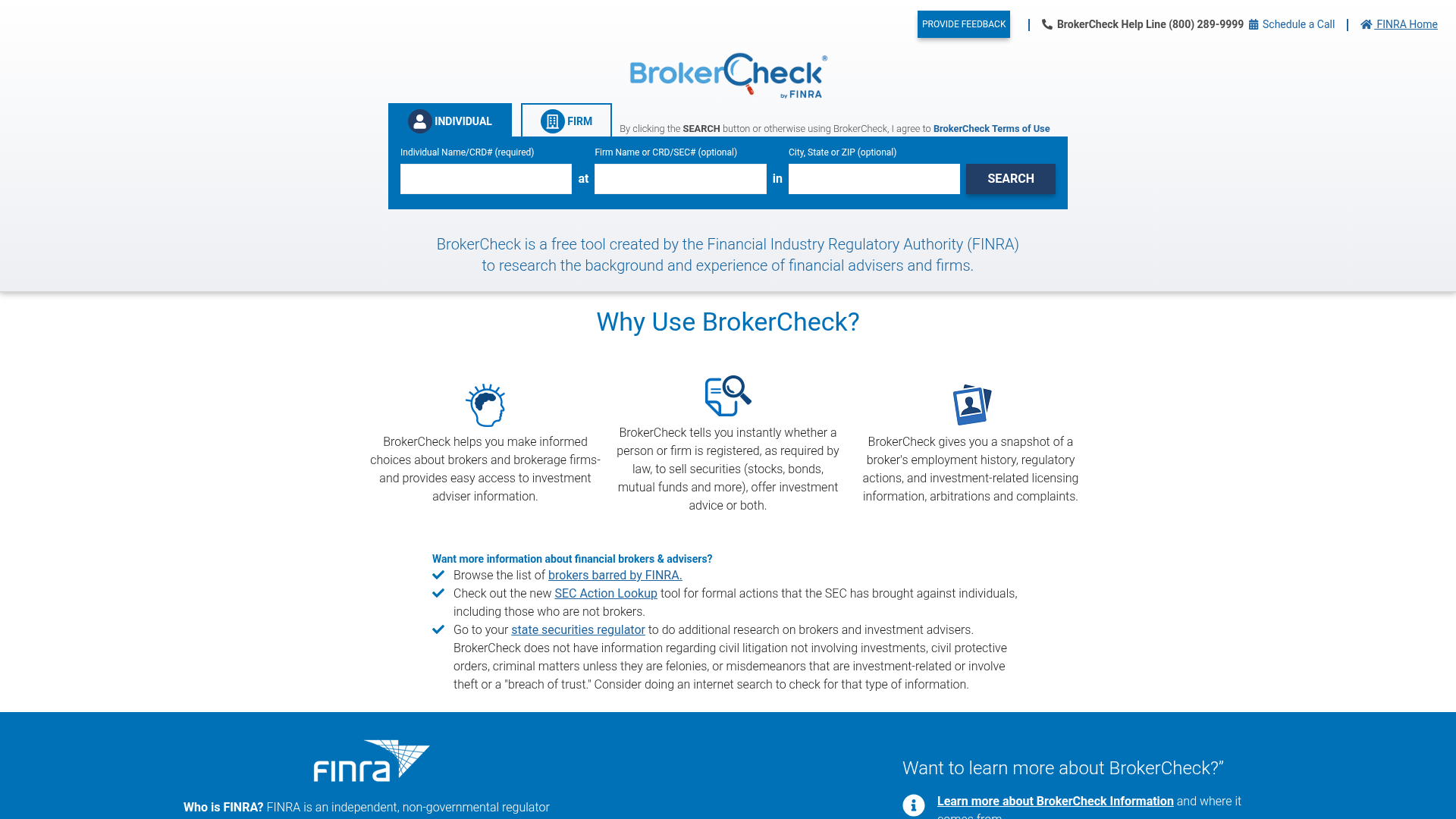
Other registers used in checks of this kind. Each opens the authority's own page.
Primary sources
Every claim above can be checked against the authority's own page. These open on the regulator's site, not ours.
- Financial Conduct Authority — Financial Services Registerregister.fca.org.ukhttps://register.fca.org.uk/
- FCA — Warning list of unauthorised firmsfca.org.ukhttps://www.fca.org.uk/consumers/warning-list-unauthorised-firms
- CFTC — Registration Deficient (RED) Listcftc.govhttps://www.cftc.gov/check
- IOSCO — Investor alerts portaliosco.orghttps://www.iosco.org/investor_protection/?subsection=investor_alerts_portal
- Financial Services Compensation Scheme (FSCS)fscs.org.ukhttps://www.fscs.org.uk/what-we-cover/investments/
- FTC — Report fraudreportfraud.ftc.govhttps://reportfraud.ftc.gov/
Frequently asked
What is the primary indicator pipvet.com uses to flag a firm?
The primary indicator is the absence of appropriate and verifiable regulatory authorization in the jurisdiction where the firm offers services, confirmed directly with the official regulator's register.
Can a firm be on the watchlist if it has a license in an offshore jurisdiction?
Yes. If a firm primarily targets clients in a regulated jurisdiction (e.g., EU, UK, Australia) but only holds a license from an offshore entity (e.g., Seychelles FSA) without the required local authorization, it will be flagged for unlicensed operation.
How does pipvet.com handle individual complaints against a firm?
Individual complaints are aggregated. We look for consistent, recurring patterns of similar issues (e.g., multiple reports of withdrawal failures) across various users and sources, especially when corroborated by other evidentiary factors like regulatory warnings.
What should I do if I find a firm on pipvet.com's watchlist?
Exercise extreme caution. Do not deposit funds or engage with the firm. If you have already interacted with them, gather all evidence and report your experience to your national financial regulator and fraud reporting agencies.
Are there any specific types of claims that immediately raise suspicion?
Yes, any claims of 'guaranteed profits,' 'risk-free trading,' or excessive pressure to deposit large sums quickly are immediate red flags. Legitimate trading involves risk, and ethical brokers do not make such promises.
Does being on the watchlist mean a firm is definitely a 'scam'?
pipvet.com uses precise language: a watchlist entry indicates that verifiable evidence points to operations that may place client funds at undue risk, or the firm appears to be operating without proper authorization. We avoid bare verdicts like 'scam' without legal judgment.